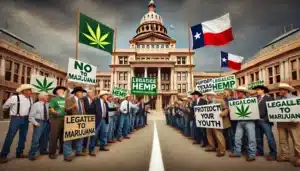
Despite marijuana legalization spreading across the United States, more than 200,000 Americans were arrested for marijuana possession in 2025, according to the FBI’s latest national crime data.
The numbers highlight a continuing contradiction in American cannabis policy: marijuana is legally regulated for adult use in nearly half the country, while hundreds of thousands of people are still entering the criminal justice system over cannabis.
Marijuana Arrests Increased in 2025
FBI data shows 200,960 marijuana possession arrests in 2025, up from 187,792 in 2024. Another 17,192 arrests involved alleged marijuana sales or manufacturing, compared with 16,244 the previous year.
Altogether, marijuana accounted for approximately one-quarter of all drug arrests, more than any other specifically identified substance. About 92 percent of cannabis-related incidents involved possession rather than sales or manufacturing.
The reported increase comes despite the longer-term decline in marijuana enforcement that has accompanied legalization and decriminalization across much of the country.
Legal in One State, an Arrest in Another
Twenty-four states have legalized and regulated marijuana for adults, creating a dramatically different legal landscape than existed a decade ago.
Yet cannabis remains subject to a patchwork of state and federal laws. Conduct that is perfectly legal at a licensed dispensary in one state can potentially result in criminal charges after crossing into another jurisdiction.
That divide remains particularly relevant across the Southwest, where cannabis laws can change significantly simply by crossing a state line.
The Numbers Could Be Even Higher
There is another important caveat to the FBI figures: they don’t necessarily capture every marijuana arrest.
About 13 percent of state and local law-enforcement agencies did not contribute data for 2025, according to the report. The FBI uses estimation procedures to compensate for incomplete reporting, and changes in reporting methodology have also made year-to-year comparisons more difficult.
That means the 200,960 possession figure should be viewed as part of a broader national picture rather than a perfect accounting of every cannabis arrest.
Federal Marijuana Policy Is Changing, Too
The enforcement numbers arrive while federal marijuana policy continues undergoing one of its most significant changes in decades.
The federal government is moving through the process surrounding marijuana’s placement under the Controlled Substances Act, with the DEA arguing in its recent filing that cannabis no longer meets the statutory requirements for Schedule I and that its abuse and dependency profile more closely aligns with Schedule III substances.
But changing marijuana’s federal scheduling status does not automatically legalize recreational marijuana nationwide or erase the state laws responsible for many possession arrests.
America Still Has Two Cannabis Systems
The latest FBI numbers illustrate where American cannabis policy stands in 2026.
There is now a multibillion-dollar regulated cannabis industry operating legally across much of the country. Millions of Americans can purchase marijuana from licensed businesses and states collect substantial tax revenue from those transactions.
At the same time, more than 200,000 marijuana possession arrests were recorded in a single year.
Until federal and state cannabis laws become more consistent, Americans will continue living under two very different systems—one where cannabis is a regulated consumer product and another where possessing it can still mean handcuffs, court dates and a criminal record.
Source: FBI crime data, as reported by Marijuana Moment.
For much of the hemp industry, Texas became the first chamber inside the Temple of Doom as new restrictions on hemp-derived THC products took effect. Retailers pulled products from their shelves, manufacturers halted production, and thousands of businesses found themselves navigating one of the most uncertain moments since the passage of the 2018 Farm Bill.
>
But the adventure isn’t over.
Beyond the first chamber lies an even greater challenge: Washington, D.C.
As Congress approaches the November 12 deadline, lawmakers face a decision that could reshape the future of hemp across the United States. At the center of the debate is proposed federal language that critics say could dramatically narrow the legal hemp marketplace by changing how compliance is measured.
To many in the industry, the countdown has begun.
Farmers, processors, distributors, smoke shops, wellness retailers, and manufacturers are watching Capitol Hill with growing concern. Millions of dollars in investment—and thousands of American jobs—could be affected depending on how Congress chooses to proceed.
Supporters of tighter federal rules argue stronger oversight is needed to close loopholes involving intoxicating hemp products and to create clearer standards for regulators and consumers. Industry advocates counter that broad restrictions could unintentionally damage legitimate businesses that have operated legally under existing federal law for years.
Several members of Congress, including Senator Rand Paul, have voiced support for protecting legal hemp and preserving the intent of the 2018 Farm Bill. Industry organizations continue urging lawmakers to pursue reforms that target bad actors without dismantling an industry that has become an important part of American agriculture and small business.
For hemp businesses, November 12 represents more than another legislative deadline.
It is the moment when Congress must decide whether to reinforce the foundation of the legal hemp industry—or allow new restrictions to redefine it.
Like every great adventure, the ending has not yet been written.
The torch is still lit. The clock is still ticking. And somewhere beyond the final chamber of the Temple of Doom, the future of America’s hemp industry awaits.
Why the New DSHS Rules Demand Immediate Legal Challenge
The Department of State Health Services has finalized sweeping amendments to 25 Texas Administrative Code Chapter 300, the regulatory framework governing the manufacture, distribution, and retail sale of consumable hemp products in Texas. These revisions, adopted by the Texas Health and Human Services Commission, represent the most aggressive regulatory intervention in the hemp market since HB 1325 legalized the industry in 2019.
The agency presents these changes as a routine response to Executive Order GA-56 issued by Governor Greg Abbott on September 10, 2025, which directed regulators to strengthen age restrictions, testing standards, and compliance requirements within the hemp marketplace. What has emerged, however, is not a modest regulatory update. It is a sweeping administrative rewrite of the legal framework governing hemp commerce in Texas.
The record of the rulemaking itself reveals the depth of concern surrounding these changes. During the public comment period, DSHS received 1,421 comments from retailers, manufacturers, trade associations, advocacy groups, and individual citizens. The overwhelming majority opposed the proposed rules, warning that the measures would exceed statutory authority, impose crushing costs on lawful businesses, and destabilize a market that the Texas Legislature deliberately created. DSHS acknowledged these objections but largely dismissed them, adopting most of the rules substantially as proposed.
The final result is a regulatory package that raises serious constitutional, statutory, and administrative law concerns.
Administrative Overreach Masquerading as Regulation
HB 1325 was enacted with a clear and limited purpose: to establish a lawful marketplace for hemp products consistent with federal law. The statute authorized DSHS to regulate manufacturing, distribution, and retail sale of consumable hemp products. It did not authorize the agency to extinguish the industry through administrative maneuver.
Yet the newly adopted rules risk doing exactly that.
The amendments impose annual licensing fees of $10,000 per facility for manufacturers and $5,000 per location for retailers, dramatically increasing the cost of participating in the hemp marketplace. DSHS justified these increases as necessary to fund inspections, laboratory testing, administrative enforcement proceedings, and cooperative enforcement activities with the Texas Alcoholic Beverage Commission and the Department of Public Safety.
These are not minor adjustments. They represent a structural shift toward an enforcement-heavy regime that treats hemp businesses less like ordinary retailers and more like regulated vice industries. For small operators, particularly independent shops serving rural communities, the new fee structure alone may prove unsustainable.
The THCA Redefinition: A Regulatory End-Run Around the Legislature
The most consequential change lies in the agency’s redefinition of how THC content is calculated.
Under the amended rules, laboratories must calculate “total THC” by including tetrahydrocannabinolic acid (THCA) along with delta-9 THC, accounting for the chemical conversion of THCA into THC during heating.
At first glance, the change appears technical. In reality, it carries sweeping consequences for the marketplace.
Many hemp flower products sold lawfully in Texas contain THCA levels that exceed the 0.3 percent delta-9 THC threshold once conversion is taken into account. By redefining THC to include the theoretical conversion of THCA, regulators have effectively rendered large segments of the hemp flower market unlawful without any vote by the Texas Legislature.
This maneuver illustrates a classic form of administrative overreach. Agencies possess authority to interpret statutes and implement regulations. They do not possess authority to rewrite legislative policy decisions through regulatory interpretation.
A Compliance Structure Designed to Break the Market
The amended rules also impose an expansive network of compliance obligations across the entire hemp supply chain.
Manufacturers must conduct extensive testing for cannabinoid content, residual solvents, pesticides, heavy metals, and microbiological contaminants. Retailers must verify packaging compliance, maintain documentation, and ensure that every product meets detailed labeling requirements derived from federal food regulations.
The rules further authorize unannounced inspections by DSHS and the Texas Alcoholic Beverage Commission, and businesses must consent to these inspections as a condition of obtaining or maintaining licensure.
Taken individually, many of these provisions might appear manageable. Taken together, they create a dense regulatory architecture that will strain even well-capitalized operators. Smaller businesses, which form the backbone of the Texas hemp retail sector, may find the cumulative burden impossible to sustain.
The Political Context Behind the Rulemaking
These regulatory changes did not arise in a political vacuum.
For several years, prohibition-minded officials have attempted to frame hemp as a public safety crisis, despite the absence of credible evidence supporting such claims. Legislative attempts to impose sweeping bans have repeatedly encountered resistance from industry stakeholders and lawmakers who recognize the economic importance of the hemp market.
Faced with those obstacles, policymakers have increasingly turned to administrative rulemaking as an alternative route to impose restrictions that could not easily pass through the legislative process.
This approach carries an undeniable political logic. Regulations can accomplish quietly what legislation struggles to achieve publicly. But that strategy also carries legal risks, because administrative agencies remain bound by the limits of statutory authority.
When those limits are exceeded, the courts provide the proper forum for correction.
Why a Lawsuit Should Be Filed Immediately
The Texas hemp industry now faces a pivotal decision. Businesses can attempt to comply with a regulatory regime that threatens their economic survival, or they can challenge the legality of these rules in court.
A legal challenge is not merely justified. It is essential.
Several fundamental legal questions demand judicial review. One concerns whether DSHS exceeded the authority granted under Texas Health and Safety Code Chapter 443 by effectively redefining hemp through the inclusion of THCA conversion in total THC calculations. Another concerns whether the agency imposed regulatory burdens, particularly licensing fees and compliance requirements, that are disproportionate or unsupported by legislative authorization. A third concerns whether the rulemaking process itself complied with the procedural requirements of the Texas Administrative Procedure Act, which obligates agencies to provide meaningful justification for regulatory changes and to engage seriously with public objections.
These are precisely the kinds of disputes that courts exist to resolve.
The Industry’s Moment of Decision
Texas now stands at a crossroads.
One path leads toward a tightly restricted hemp market dominated by a small number of large operators capable of navigating an increasingly complex regulatory system. The other preserves the open, entrepreneurial marketplace that HB 1325 was intended to create when the Legislature legalized hemp production and commerce.
Moments like this test whether the rule of law remains meaningful in the face of administrative power. The courts exist precisely to address such questions.
For the Texas hemp industry, the moment for hesitation has passed. The rules have been written. Their consequences are already visible.
What remains is the willingness to challenge them.
Texas has a way of clarifying things. You can talk theory all day in a committee room, but sooner or later somebody’s boots hit the ground and you find out what the law actually means. That is where we are with federal cannabis policy right now—caught between a reform signal from the White House and the unmistakable sound of warehouse doors being kicked in.
In December 2025, President Donald Trump signed an executive order directing the federal government to move marijuana from Schedule I to Schedule III. That may sound like a bureaucratic reshuffling, but anyone who has spent time navigating the Controlled Substances Act knows the difference is not cosmetic. Schedule I is the legal fiction that cannabis has “no accepted medical use.” Schedule III acknowledges medical value and relaxes some of the most punitive structural burdens, including the tax regime that has strangled legitimate operators under Section 280E.
That was the signal from Washington: modernization. Alignment. A tacit admission that pretending cannabis belongs in the same federal category as heroin has become an exercise in self-parody.
And then came the raids.
The South Carolina Shock
In South Carolina, state and federal authorities executed sweeping enforcement actions targeting THC distributors under what prosecutors called “Operation Ganjapreneur.” Warehouses were searched. Trucks were seized. Thousands of pounds of product were confiscated. The rhetoric was familiar: highly intoxicating products, threats to children, narcotics charges.
Federal participation reportedly included the Drug Enforcement Administration, reminding everyone that even in a moment of federal policy transition, enforcement muscle remains fully flexed.
That is not an abstract policy debate. That is inventory in an evidence locker and people in handcuffs.
If you are an operator in Texas, that story does not feel distant. It feels like déjà vu.
Texas Has Lived This
We know this movie in Texas. We have watched hemp retailers operate in good faith under statutory language derived from the 2018 Farm Bill, only to find themselves facing seizures based on disputed lab interpretations. We have seen regulators struggle to reconcile evolving cannabinoid science with statutes drafted before anyone outside a chemistry lab had heard of delta-8. We have watched prosecutors test the outer edges of ambiguity because ambiguity is where discretion lives.
The 2018 Farm Bill did not hide its language. Hemp and all derivatives, extracts, cannabinoids, and isomers under 0.3 percent delta-9 THC were removed from the Controlled Substances Act. Congress wrote it. The President signed it. Markets responded. If legislators later decided the consequences were broader than anticipated, that is a drafting problem, not a smuggling conspiracy.
As James Madison warned in Federalist No. 62, “It will be of little avail to the people that the laws are made by men of their own choice if the laws be so voluminous that they cannot be read, or so incoherent that they cannot be understood.” We are living in the incoherence he feared.
The Republican Family Argument
This moment is not a clean partisan fight. It is an internal Republican argument.
Some lawmakers have publicly suggested that the President was “poorly advised” to move toward Schedule III. Their objection is procedural: that rescheduling amounts to an end-run around the FDA’s drug approval framework. Research, they argue, can proceed without altering federal classification.
That position is not merely technical. It reflects a worldview that treats drug scheduling as a cultural boundary marker. If you move the line, you concede ground.
On the other side are voices arguing that rescheduling is simply catching federal law up to political and medical reality. Longtime Trump ally Roger Stone has publicly urged the move, framing it as both substantively defensible and politically savvy. Cannabis reform polls well. Voters across party lines support medical access. The states have already moved.
This is not a debate about botany. It is a debate about governance and narrative.
The Culture-War Reflex
When enforcement rhetoric lumps cannabis together with fentanyl and cartel trafficking, the public hears a simple story: drugs are drugs. But cannabis is not fentanyl. Hemp-derived THC products sold in storefronts are not clandestine meth labs run by transnational syndicates.
Agencies like the Federal Bureau of Investigation understandably focus on dismantling violent criminal networks. That mission is legitimate and necessary. The danger arises when the language of that mission bleeds into areas where regulation, not eradication, is the appropriate tool.
Texas humor has a way of cutting through this. If you treat a mesquite bush like it’s a forest fire, you end up calling in helicopters for a backyard barbecue.
Reform Must Survive Contact with Reality
An executive order is direction. A raid is consequence.
If Schedule III becomes the operative federal posture, enforcement priorities should reflect that transition. That does not mean anarchy. It does not mean ignoring bad actors. It means calibrating response to actual harm rather than political optics.
The lesson from South Carolina is not that reform has failed. It is that reform without alignment creates instability. Businesses do not operate well in twilight zones. Investors do not deploy capital where statutory interpretation shifts by press conference.
Texas has every reason to watch this carefully. Our Legislature, our regulators, and our law enforcement agencies will inevitably confront the same tension between federal signals and state statutes. We can choose clarity through legislation and transparent rule-making, or we can choose episodic enforcement theatrics.
As Sam Houston once observed, “A leader is one who helps improve the lives of other people or improve the system they live under.” Modernizing cannabis policy is not about indulgence. It is about improving a system that has long been riddled with contradiction.
The story unfolding right now is not whether cannabis will remain controversial. It will. The story is whether American law can align itself with reality without swinging from neglect to overreaction.
Policy is not what is announced at a signing ceremony in Washington. Policy is what happens when the warrants are served and the courtroom doors close.
That is where reform proves itself—or exposes itself as rhetoric.
The next chapter of this series will examine what Schedule III actually changes on the ground and whether it meaningfully restrains the enforcement machinery we just watched in motion.
Because in Texas, we do not judge policy by applause lines.
Texas does not have a marijuana industry. It has a hemp industry that Congress legalized in 2018 when President Donald Trump signed the Agriculture Improvement Act of 2018 into law. That statute removed hemp and “all derivatives, extracts, cannabinoids, isomers, acids, salts, and salts of isomers” containing no more than 0.3 percent delta-9 THC from the Controlled Substances Act. It was not ambiguous. It was not an accident. It was bipartisan and it was intentional.
Texas responded. Farmers planted. Processors invested. Retailers signed leases. An entire supply chain emerged around what is now a six-to-eight-billion-dollar Texas hemp market. That number is not a fever dream. It reflects retail, wholesale, manufacturing, logistics, and the secondary economic effects of a rapidly scaling consumer sector. Whether one likes the products or not, this is not a hobby economy.
And now we are in a trade war with China.
That matters.
Because if the stated national policy is economic sovereignty, domestic manufacturing, and protecting American supply chains from foreign capture, then the enforcement posture toward hemp deserves scrutiny. Texas entrepreneurs who relied on the text of the 2018 Farm Bill are facing regulatory whiplash and criminal exposure in some jurisdictions. At the same time, there is growing national concern about Chinese-linked criminal networks operating illegal marijuana grows in states with loose licensing systems, and about foreign chemical supply chains that feed gray and black markets in synthetic cannabinoids.
These are separate phenomena. But politically, they are colliding.
The hard question is this: are we protecting American producers, or are we destabilizing them while foreign competitors and illicit networks fill the vacuum?
If aggressive enforcement and regulatory ambiguity suppress domestic hemp operators in Texas, the market does not vanish. Consumer demand does not evaporate because a press conference was held. Markets adapt. Supply shifts. If legitimate, tax-paying Texas businesses are squeezed, the logical beneficiaries are out-of-state actors, offshore chemical suppliers, and illicit networks operating beyond transparent oversight.
That is not conjecture. It is how markets behave.
The intoxicating hemp segment exists because Congress legalized hemp broadly and because chemists learned how to work within that definition. THCa flower, delta-8, and other hemp-derived cannabinoids did not emerge from a conspiracy; they emerged from statutory text and innovation. Whether lawmakers now regret the breadth of that language is a separate political debate. But regret does not rewrite history.
If the United States is serious about economic competition with China, then domestic agricultural and manufacturing sectors should be strengthened, not destabilized through inconsistent interpretation. Texas hemp businesses are American small businesses. They hire locally. They pay Texas taxes. They lease Texas property. They operate under state registration systems.
One can argue for tighter standards. One can argue for clearer labeling. One can argue for age restrictions or potency caps. Those are regulatory debates. But criminalizing ambiguity while foreign supply chains remain fluid is not economic nationalism. It is self-inflicted asymmetry.
The China narrative is powerful because it taps into real anxieties about supply chain vulnerability, intellectual property theft, and chemical precursor markets. But it becomes incoherent if domestic entrepreneurs are treated as expendable collateral damage in the same breath.
Here is the uncomfortable tension: President Trump legalized hemp. Texas built an industry on that legalization. Now, in the middle of an escalating trade conflict with China, enforcement uncertainty threatens to push market share away from transparent American operators and toward actors far less accountable to U.S. regulators.
If we are in an economic war, strategy matters. You do not weaken your own productive base while invoking sovereignty.
Texas is uniquely exposed in this debate because of the size of its hemp economy and the state’s political alignment with national trade rhetoric. A six-to-eight-billion-dollar market is not a rounding error. It is jobs in Houston warehouses, manufacturing equipment in Dallas facilities, retail payroll in San Marcos strip centers, and rural acreage planted with hemp instead of fallow fields.
The question is not whether reform is needed. The question is whether reform strengthens domestic producers or drives capital offshore.
Nationalism, if it means anything, must include coherent domestic policy. Otherwise it becomes theater.
A Cautionary Tale of Federal Taxes and Recreational Lobbying
Originally passed by the Texas Legislature and signed by Governor Abbott in 2015, the Texas Compassionate Use Program was structured with the intent of a “right to try” limited program. Similar to other state medical cannabis programs, the intent was to allow patients with a handful of qualifying conditions, such as epilepsy or cancer, to “try” an alternative substance – strictly under physician supervision. Oversight of this program was given to the Texas Department of Public Safety, to ensure proper regulations were enacted and enforced. To be clear, the Texas Compassionate Use Program is not a recreational marijuana program.
The Department of Public Safety is currently holding an open RFP to expand the number of licensed organizations allowed to participate in the program to facilitate stronger patient access under House Bill 46. A wide array of applicants are expected to apply, including not only Texas based medical operators, but also multi-state operators (“MSOs”) located outside of Texas – many of which trade on Canadian exchanges and distribute recreational marijuana across various foreign and domestic markets. Texas DPS should be wary – inviting such MSOs, or their affiliated entities (“Affiliates”), into the Compassionate Use Program will set the stage for a strong push toward a recreational marijuana market in the State of Texas.
Florida Market: Recreational Foresight
The State of Florida provides a perfect case study. Initially signed into law by Governor Rick Scott in 2014, the Florida medical market has grown in leaps and bounds. Estimated reports show that in 2024, the medical market surpassed $2B in gross annual sales, making Florida one of the largest medical markets in the country. But this has not been enough. Since 2019, a gang of MSOs have continuously pressured the market to become recreational, with the intent of rivaling the California recreational market of today.
Most recently, this effort was defeated in November 2024 by Governor Ron DeSantis and the Florida Freedom Fund PAC. At the time, MSOs had spent over $150M on the rec campaign. The primary supporter of this campaign, Trulieve LLC (Tallahassee, FL), even sued the Republican Party of Florida itself in October 2024, claiming that the FL GOP published material intended to convince Florida voters to vote against a measure that would “…legalize the recreational use of cannabis in Florida…”. Trulieve has been one of the largest domestic MSOs in the United States since its late 2021 acquisition of Harvest Health & Recreation, a recreational company out of Phoenix, AZ. Select leadership of Harvest has since started a new recreational MSO – Story Cannabis Co.
A review of the Florida Division of Election’s contribution records for the Make It Legal Florida PAC and the Smart & Safe Florida PAC shows the breakdown of capital donated to turn Florida recreational.
Compare these donations to the expenses incurred by Las Vegas Sands in its attempt to bring gambling to the State of Texas. According to Texas Monthly, Las Vegas Sands spent roughly $13 million between January 2024 and July 2025, spread across over one hundred different lobbyists, to push their agenda. Imagine what out-of-state MSOs, both foreign and domestic, are willing to spend to bring recreational marijuana to Texas.
Federal Legalization
Perhaps equally as concerning as efforts to turn red states into recreational marijuana meccas are the efforts being made at the federal level. Led by MSOs and Canadian operators, efforts to reschedule or legalize marijuana use continue through a dizzying array of efforts, including spending millions on lobbying and various lawsuits across the federal government.
As an example, the lawsuit filed against the United States Attorney General by certain parties (including the Chicago MSO Verano Holdings Corp.) in October 2023, which claimed that cannabis prohibition in state markets was unconstitutional. A press release for the lawsuit lists several “foundational supporters”, including Green Thumb Industries (Chicago, IL), Ascend Wellness (Morristown, NJ) and TerrAscend (Ontario, CAN). The case was dismissed by a federal district judge in July 2024.
Federal Taxes & 280E
Despite all such efforts, marijuana remains a Schedule I substance in the United States. The question is then asked “If cannabis is federally illegal, why is the federal government not shutting down all state licensed cannabis companies?”. This is because of the Rohrabacher-Blumenauer Amendment (previously the Rohrabacher-Farr Amendment), which has been adopted every year since 2014. This amendment prohibits the Justice Department from spending funds to interfere with state medical cannabis programs. Note: This amendment only applies to state medical programs – not recreational programs. Out-of-state MSOs operating in recreational markets with the perception of nigh impunity continue to do so at the risk of DOJ enforcement.
Notably, this exception for state medical cannabis operators only affects USDOJ enforcement and does NOT extend to the mandatory payment of federal taxes under the purview of the IRS. Since the case of Edmondson v. Commission (1981) which considered whether or not an amphetamine, cocaine, and cannabis dealer could deduct business expenses, the IRS has enforced IRC Section 280E. Section 280E stipulates that any business that trafficks in controlled substances prohibited by federal law is not allowed to deduct business expenses from its federal taxes. This policy has stringently applied to the entirety of the marijuana industry (both medical and recreational) and has been enunciated as such by the IRS as recent as its IR-2024-177 announcement on June 28, 2024, stating “…the Internal Revenue Service today reminded taxpayers that marijuana remains a Schedule I controlled substance and is subject to the limitations of Internal Revenue Code…Section 280E disallows all deductions or credits for any amount paid or incurred in carrying on any trade or business that consists of illegally trafficking in a Schedule I or II controlled substance within the meaning of the federal Controlled Substances Act. This applies to businesses that sell marijuana, even if they operate in states that have legalized the sale of marijuana…”. As Benjamin Franklin would say “nothing can be said to be certain, except death and taxes”.
Unfortunately, it would seem that Benjamin Franklin did not consider out-of-state marijuana companies when he made this statement. To showcase this, one needs to look no further than the reported billions in accrued federal taxes owed by publicly traded MSOs, most of whom have publicly announced their intent to disregard the official position of the Internal Revenue Service. Consider Curaleaf Holdings, a leading international MSO founded by Boris Jordan (past CEO of Gazprom Media and founder of the Sputnik Group), which counts the Russian oligarch Roman Abramovich as an original investor. As stated in their Q2 2024 filing: “As of June 30, 2024, the Company has adopted a new federal and state income tax position, asserting that the restrictions of Section 280E of the Internal Revenue Code (“Section 280E”) do not apply to the Company’s cannabis operations”. Instead, such companies have implemented terms, such as “uncertain tax liabilities” or “deferred tax liabilities” to separate out federal taxes on the balance sheet and present a certain financial picture.
An abridged list of similar companies is provided below.
State Market Reaction
Medical cannabis markets have started to notice. The State of Alabama conducted a similar RFP to that as the State of Texas back in late 2022, with the intent of issuing licenses in Summer 2023. Administered by the Alabama Medical Cannabis Commission (“AMCC”), the option was provided to have all applicants evaluated by a third-party agent, but the AMCC reserved the right to “…act independently of any third-party evaluation…” and award licenses at their discretion.
In June 2023, an article was published in the Alabama Political Reporter (APR) “Questions Surround Medical Cannabis Scoring: No. 1 Reportedly Owed $150 Million to IRS”. In the article, APR writes that Verano Holdings Corp. had “…$161.4 million owed to the IRS compared with its $92.8 million cash on hand – meaning it owes 78 percent more in taxes that it had in cash at the end of its second quarter…”. The article goes on to quote Verano leadership as having stated that “The cost of penalties and interest for this are significantly below the available cost of debt”. This means that Verano consciously decided that not paying federal taxes was cheaper than raising more debt. Despite receiving a high score from third-party agents, Verano was not awarded a license in the most recent licensing round conducted by the AMCC. The company has since doubled down with a tax approach similar to that of Curaleaf, stating in its Q4 2024 call earnings presentation that “From a tax perspective consistent with many of our peers, we’ve taken a position that we do not owe taxes attributable to the application of Section 280E of the Internal Revenue Code.” The Q3 2025 report for Verano now reports projected federal tax liabilities of approximately $419.2MM (summation of $14.3MM in “Income tax payable”, $333.907MM in “Uncertain tax positions” and $71.023MM in “Deferred income taxes”).
Equally as disturbing is the crushing debt owned by such companies. State medical markets seek ownership information from applicants to analyze qualifications, as well as to take preemptive measures against future diversion and criminal involvement. Such a measure appears somewhat futile if a third-party debtor, removed from such analysis, could potentially call such debt in the near future.
This is no new development. In recent years, multiple MSOs have shuttered or been reorganized due to debt, including AYR Wellness, which in July 2025 declared it was entering into a Restructuring Support Agreement, having owed roughly $622.0MM to outside parties at the time (see MJBizDaily article “Debt-saddled Marijuana MSO Ayr Wellness to Sell Off Assets, ‘Wind Down Operations’ , and MedMen, the OG cautionary tale of cannabis collapses, which in April 2024 declared bankruptcy, having owed roughly $411.0MM to outside parties at the time.
Texas Compassionate Use Program
Thankfully, the leadership at TXDPS Regulatory Services Division (“RSD”) already appears to be aware of many of these issues. A review of the FAQs published by the department instructs applicants to “…report any outstanding state or federal tax liabilities or debt obligations…” when describing the financial situation of the company. Although the State of Texas has no income tax, it does have similar tax laws (such as regarding franchise taxes), under Texas Tax Code, which applies to companies and their “affiliated groups” or parent companies. Willful nonpayment of such constitutes a felony under Texas Penal Code Chapter 71. And Rule §12.3 of the Compassionate Use Program already stipulates offenses under which any individual can be deemed unfit for participation in the program, while also stating that “…the department may find that an offense not described in this subsection also renders an individual unfit…” for participation.
The Alabama scenario does provide an interesting issue with competitive RFPs, especially those that pertain to controlled substances and subsequent evaluation of applicants. The intent of a statewide RFP, such as that for the Compassionate Use Program, is to solicit applicants that will best serve the purposes of the program in question – but beyond the rose-colored picture provided by applicants, how is an agency expected to receive the full picture? It is unlikely that companies and their Affiliates applying to the Compassionate Use Program would openly declare their aggressive positions on recreational marijuana or deferred taxes to the statewide law enforcement agency of the State of Texas that is responsible for protecting Texas communities and citizens from cartels and organized crime.
It is even less likely that the same applicants will provide evaluators sufficient information to ascertain between (a) true Texas based companies, (b) MSOs and (c) the various other applicant entities (“Affiliates”) that are already affiliated with active MSOs as well – such affiliates are typically identified as having current or ex-MSO leadership on their team, or private leadership with a catch and release history of securing state licenses, only to offload to an MSO in the imminent future. Possible examples would be Texas Patients Group, LLC, RNF Texas, LLC, and Lonestar Compassionate Care Group, LLC, each showing TXSOS management persons that appear to have the same names as current or ex-MSO leadership at Curaleaf Holdings Inc. (Samford, CT), MariMed Inc. (Norwood, MA), and Green Thumb Industries Inc. (Chicago, IL) respectively. Such a strategy can be used to backdoor publicly traded MSOs into states that wish to avoid recreational lobbying and work with local interests. Should the RSD therefore consider allowing public comments on the application process?
The Texas Compassionate Use Program is not a recreational program – and Texas is not a recreational marijuana state. This state embraces law and order, a position firmly taken by our Governor, our Lt. Governor and our State Legislature. TXDPS should be wary of foreign and domestic MSOs, as well as their Affiliates, to mitigate bad actors and ensure this great state can continue to protect our communities. Let’s make sure Texas stays Texas.
Texas regulators have once again shifted the ground beneath the state’s hemp industry. On September 23, the Texas Alcoholic Beverage Commission (TABC) issued an emergency rule barring the sale of consumable hemp products to anyone under twenty-one. The rule took effect immediately, but enforcement will not begin until October 1, leaving retailers scarcely a week to adapt. For shop owners, that means updating signage, retraining staff, and putting new compliance systems in place at breakneck speed.
The language of the rule is blunt. Any TABC license or permit holder who also holds the Department of State Health Services’ consumable hemp registration is now prohibited from selling or delivering hemp products of any kind to customers younger than twenty-one. A valid, government-issued ID must be checked at the point of sale, and failure to do so can result in the most severe penalty the agency has at its disposal: cancellation of the license. TABC officials did carve out a narrow safe harbor—if a seller examines an ID in good faith, the customer misrepresents their age, and the seller reasonably believes the buyer to be over twenty-one, then the retailer is shielded from punishment.
For the industry, this is not a minor adjustment but a dramatic escalation. One Austin retailer told Blazed News, “They’ve moved the goalposts again—and if we screw up once, they can take our license away. No fines. No warnings. Straight to cancellation.” Many stores already card their customers, but the stakes of a mistake have never been higher. A single lapse could shut down a business that has otherwise followed the law.
The rule flows directly from Governor Greg Abbott’s Executive Order GA-56, which called for tougher restrictions on hemp and THC products under the banner of protecting youth. By invoking its broad authority under the Alcoholic Beverage Code—particularly provisions allowing cancellation for conduct deemed harmful to public health and safety—TABC has given Abbott his first concrete enforcement action since the order was issued earlier this month.
The practical impact will be felt immediately. Shops that once counted younger adults among their customer base are bracing for a revenue hit, with some estimating that ten to fifteen percent of sales could disappear overnight. Compliance costs are also rising: owners are scrambling to train staff on proper ID inspection, upgrade point-of-sale systems, and draft written policies to demonstrate diligence if enforcement agents come calling.
Perhaps the greatest source of unease lies in the rule’s lack of precision. It does not spell out exactly what constitutes a “consumable hemp product.” Statute and agency practice suggest the definition includes edibles, beverages, vapes, smokable flower, and even topical products containing hemp-derived cannabinoids. But the ambiguity leaves room for confusion and, worse, selective enforcement. A retailer selling THCa pre-rolls may find themselves just as vulnerable as one offering CBD seltzers, depending on how the agency decides to interpret its own mandate.
This emergency measure is not the final word. TABC, together with the Department of State Health Services and Texas A&M AgriLife, has been tasked with developing a more comprehensive regulatory framework in the months ahead. That process could bring potency caps, stricter labeling and testing rules, and expanded enforcement authority. For now, the age restriction is the most immediate change, but it is almost certainly only the first in a series of new regulations.
The politics driving this move are no mystery. Lieutenant Governor Dan Patrick has been open about his desire to eliminate intoxicating hemp products altogether, while Abbott has staked out a slightly less extreme position. The Governor’s emergency order allows him to frame this new rule as a public-safety measure, one that does not require legislative approval yet demonstrates a firm hand. Critics, however, argue that such measures punish small businesses, ignore consumer demand, and push Texans back toward illicit markets.
For retailers, survival will depend on vigilance. Shops must ensure that every sale is backed by proper ID verification, every product is tested and documented, and every employee is trained to avoid mistakes that could cost the entire business. Many are treating this week as a crash course in compliance, drafting policies, posting new signs, and preparing to defend themselves against enforcement actions that may come swiftly once October arrives.
Texas’s hemp market has weathered raids, lawsuits, and political attacks before. But this new rule is a reminder of how quickly the landscape can change—and how much power state regulators wield over the future of an industry that has only recently found its footing. Whether it proves to be a commonsense guardrail or simply another step toward prohibition depends on who is telling the story. What is certain is that the battle over hemp in Texas is far from finished.
WASHINGTON, D.C. — September 17, 2025 — U.S. Senator Rand Paul (R-KY), one of hemp’s most consistent defenders on Capitol Hill, issued a stark warning this week: unless Congress changes course, language buried in pending federal spending bills could “eradicate the hemp industry” within two weeks.
Speaking on The Dales Report podcast and to other outlets, Paul said prohibitionist provisions under discussion would redefine hemp so that any detectable amount of THC—not the current 0.3% threshold set by the 2018 Farm Bill—would render a product illegal.
“If we adopt a zero-THC standard, we will wipe out CBD oils, gummies, and the entire value chain that farmers and small businesses rely on,” Paul cautioned. “This isn’t what Congress intended when we legalized hemp.”
Why This Matters
• Farmers and processors would be forced to destroy crops or products that test above zero THC—even trace amounts naturally present in hemp.
• Retailers and consumers could lose access to widely used CBD and minor-cannabinoid products.
• The move would represent a dramatic reversal of the bipartisan hemp legalization achieved seven years ago.
Paul’s Alternative Approach
Paul urged lawmakers to focus regulation on finished consumer products, not raw hemp biomass or plants in the field. Under his view, regulators could impose safety standards—labeling, child-resistant packaging, accurate potency testing—without collapsing an industry that supports tens of thousands of jobs nationwide.
He noted that similar prohibitionist language had appeared in an earlier Senate appropriations draft but was stripped after objections from himself and other pro-hemp senators. However, he warned, new amendments could re-insert a ban during final negotiations.
Industry Response
Hemp advocacy groups and trade associations are sounding the alarm. Many argue that Congress should modernize testing protocols, not revert to prohibition. Some have pointed to Texas Governor Greg Abbott’s recent executive order on consumable hemp products as an example of state-level regulation that—while controversial—still preserves a path forward for compliant businesses.
What’s Next
Appropriations committees are expected to hammer out final language over the next two weeks. Stakeholders are mobilizing calls, letters, and fly-ins to Capitol Hill urging lawmakers to preserve hemp’s legal status.
For Texas operators already grappling with Abbott’s rulemaking directives, a federal crackdown would add another layer of uncertainty. Blazed News will continue tracking developments in Washington and Austin.
⸻
Call to Action:
Blazed encourages hemp entrepreneurs, farmers, and consumers to contact their senators and representatives immediately. Remind them hemp is not marijuana, that the 0.3% limit was a bipartisan compromise, and that moving the goalposts now would devastate rural economies and small businesses.
In a move that’s being called both historic and controversial, Texas Governor Greg Abbott has asked the state’s highest court to remove Representative Gene Wu from office. Abbott’s legal team filed an emergency petition on Tuesday with the Texas Supreme Court, invoking an obscure legal tool known as a writ of quo warranto. If the Court grants the petition, it would mark the first time in modern Texas history that a legislator is removed by judicial action rather than by voters or by their colleagues in the Legislature.
A writ of quo warranto is a legal proceeding used to challenge whether someone is lawfully holding public office. Latin for “by what authority,” the writ is typically used in cases where a person is accused of usurping an office they aren’t entitled to hold, or of committing acts that legally forfeit their right to continue serving. In Texas, it is most often used to challenge appointed officials who fail to meet statutory requirements, but it has rarely been applied to elected legislators.
The petition arises from the decision by Wu and dozens of House Democrats to leave Texas on August 3 in order to break quorum during the current special legislative session. By fleeing the state, they prevented the House from conducting official business, including votes on Governor Abbott’s special session priorities—chief among them, a proposed congressional redistricting map. The Democrats flew to Chicago aboard a privately chartered jet, echoing tactics used during previous quorum breaks in 2003 and 2021.
Abbott’s legal filing argues that Wu’s actions amount to abandonment of office. According to the Governor, the Texas Constitution requires that when the Governor calls a special session, the Legislature shall meet. Abbott contends that quorum-breaking violates that constitutional duty, and that a deliberate, prolonged absence for political purposes constitutes a forfeiture of the office. In addition to abandonment, the petition accuses Wu of effectively soliciting or accepting bribes. Specifically, it points to the chartered flight and political fundraising appeals tied to the quorum break as evidence that Wu received something of value in exchange for withholding his vote or official presence—an act that, if proven, could trigger automatic forfeiture of office under Article XVI, Section 41 of the Texas Constitution. The filing also argues that Wu’s indefinite absence from the state could be construed as a loss of residency, which under Article III, Section 23, would create a vacancy.
While the Texas Supreme Court has original jurisdiction to hear quo warranto petitions against state officials, the legal question remains highly unsettled. No Texas court has ever removed a legislator for participating in a quorum break. In fact, several past instances—most notably the 2003 “Killer D’s” walkout and the 1979 “Killer Bees” incident in the Texas Senate—were resolved politically, not judicially.
As of publication, Representative Wu has not filed a formal legal response. However, legal scholars and civil rights organizations have flagged several potential defenses. One of the strongest is the separation of powers argument: the Texas Constitution gives the House of Representatives the exclusive power to judge the qualifications, behavior, and discipline of its members. Wu’s team is likely to argue that if the House wants to expel or censure him, it has the tools to do so—and that the judiciary, or the Governor, has no authority to interfere in internal legislative matters.
Another possible defense is rooted in the First Amendment. Supporters of Wu’s actions contend that the quorum break is a form of protected political protest, particularly given the stakes of the redistricting debate and the legislative process itself. From this perspective, fundraising to support travel and communications during the protest is not bribery, but a lawful extension of political expression and association.
Wu may also argue that he has not abandoned his office. He has not resigned, and he continues to perform constituent services remotely. Unlike someone who ceases all contact or activity, Wu’s absence is temporary and strategic—intended to influence policy outcomes, not to abdicate responsibility. His defenders will also likely note that accepting travel assistance or campaign donations during a political protest does not, in and of itself, constitute bribery unless there is a clear quid pro quo arrangement.
Questions have also been raised about whether Governor Abbott even has the legal standing to bring this case. Under Chapter 66 of the Texas Civil Practice and Remedies Code, quo warranto actions are typically initiated by the Attorney General or a local district or county attorney, not by the Governor himself. While Abbott’s team argues that the Governor has the inherent power to seek judicial clarification on vacancies under the Constitution, others may view this as an overreach of executive authority.
Finally, the timing of the case raises issues of ripeness and potential mootness. If Wu returns to the state or the special session concludes before the Court rules, some legal observers argue that the issue could become academic. In prior cases, such as In re Turner in 2021, the Texas Supreme Court addressed aspects of quorum-breaking but declined to remove any members or define it as abandonment of office.
What makes this case particularly significant is the potential precedent it could set. If the Court finds in favor of the Governor, future walkouts—regardless of party—could be met not with political consequences, but with judicial removal. That would dramatically change the landscape of legislative protest in Texas, and potentially in other states as well.
The Texas Supreme Court has been asked to issue a ruling by Thursday, August 7, citing the urgency of the special session calendar. If the petition is granted, it would open the door to a high-profile legal showdown that pits legislative independence against executive authority, and tests the limits of protest in the digital and partisan age.
Blazed News will continue to monitor the case closely and provide updates as it develops.
WARNING: THE REPORT DAN PATRICK DOESN’T WANT YOU TO SEE!
In Texas, we’ve seen this before: a political agenda dressed up as public safety, a compliant bureaucracy, and the weaponization of bad science to justify bad law. But this time, it’s not marijuana. It’s legal hemp—and the state’s own forensic watchdog warned them not to do it.
The Science Was Clear
In July 2021, the Texas Forensic Science Commission (FSC) issued a report questioning the reliability of gas chromatography (GC) testing methods—specifically the kind used by Armstrong Forensic Laboratory—in determining THC levels in cannabis samples. The problem? GC destroys the chemical integrity of the sample by heating it, converting non-psychoactive THCa into delta-9 THC. The result: legal hemp often appears “hot” when tested this way.
By April 2025, the Commission had grown more urgent. In a formal warning, it told prosecutors and law enforcement not to rely on GC-MS without derivatization—the exact method Armstrong was using—because it does not distinguish between THCa and delta-9 THC in processed products like vape pens and edibles. The Commission’s position was clear: GC is not scientifically valid for the enforcement of Texas hemp laws. The right tool? High-performance liquid chromatography (HPLC), which preserves the cannabinoid profile without artificially inflating THC levels.
DPS Didn’t Just Ignore the Science—They Sought Out Bad Results
Despite having access to state-run, accredited labs that used validated HPLC methods, the Texas Department of Public Safety (DPS) chose Armstrong Labs. Why? Because Armstrong’s flawed GC testing produced the kind of “hot” results that could turn lawful retail inventory into felony contraband on paper.
This wasn’t just negligence—it was selective science-shopping. DPS bypassed better labs and used the one that would give them the numbers needed to justify search and arrest warrants. Those warrants led to a coordinated series of raids in August 2024 across North Texas, most prominently in Allen, where nine hemp retailers—nearly all minority-owned—were raided. Doors were kicked in. Products were seized. People were arrested. Lives were disrupted.
And when asked about the scientific controversy, DEA Special Agent Eduardo A. Chávez, standing behind a row of local police chiefs, said the quiet part out loud:
“We’re not going to get into a scientific debate.”
That’s because there was no debate. The science was already settled—just not in their favor.
Dan Patrick’s Fingerprints
The timing and utility of these raids are no coincidence. Lt. Governor Dan Patrick, a long-time prohibitionist, has made clear his desire to eliminate the hemp-derived THC market. Along with Senator Charles Perry, he introduced Senate Bill 3, a sweeping measure to criminalize and regulate hemp in ways that would effectively shut down thousands of small businesses statewide.
But Patrick’s proposals needed fuel—a sense of public danger. That’s where the Allen raids came in. News coverage of the raids, complete with sensational claims about high-THC products and cash seizures, created the illusion of widespread criminality. Those raids—and the test results behind them—became Exhibit A in the Senate’s push for SB 3.
In reality, the entire operation was built on sand. The lab method was known to be invalid. The warrants were based on forensically unsound evidence. The prosecutions have largely stalled or gone unfiled. But the political damage was done—and the policy momentum created by those raids is still being used to push bans, criminal penalties, and massive regulatory overreach.
The Consequences
Dozens of stores have closed. Millions in assets have been seized. Texas entrepreneurs—many from immigrant and minority communities—have been branded criminals for selling federally legal hemp products. Some of the retailers caught in this net can’t even afford legal counsel; their bank accounts are frozen, their reputations destroyed.
All because DPS chose the wrong lab on purpose.
If It’s Not Illegal, It’s Worse
Business Speak to Senate Hearing
Some may argue no laws were broken. But that’s the problem. When law enforcement uses scientifically invalid methods, even after being formally warned twice by the state’s own scientific authority, it isn’t just a technical error. It’s an abuse of power. Under Texas Penal Code §39.03, this pattern begins to resemble official oppression—public servants using their authority to target people unjustly under the color of law.
And the Fourth Amendment may also come into play. Raids based on scientifically discredited probable cause are ripe for constitutional challenge. The state didn’t just bend the law—it bent science, and it bent justice.
The Big Lie, Texas Edition
Dan Patrick’s prohibitionist crusade depends on the belief that hemp stores are fronts for drug dealers. But the science doesn’t support that claim, and neither do the facts. What we’re seeing is the deliberate manufacture of criminality using rigged lab results and coordinated enforcement—all to push a bill that benefits entrenched political allies and clears the market for the few operators who can afford to comply.
This is Reefer Madness 2.0—driven by bad labs, bad busts, and big lies.
Austin, TX – State legislators are considering a ban of the sale of all consumable hemp products, leaving the cannabis industry and cannabis advocates in the State of Texas in an uproar.
New cannabis legislation threatens to dismantle a $5.5 Billion industry by bringing an end to the sale of all consumable hemp products in Texas.
This will affect over 10,000 businesses in Texas according to the latest estimates, and over 55,000 jobs will be lost.
“We haven’t abused any loopholes in legislation, because we did not write the legislation nor were we asked to help or assist in the regulations” states Ahmad Alnajjar, owner of Trippiez Smoke Shop. “Everything we have sold and produced has been federally legal with the recent federal farm bill guidelines. We want safety like the legislators do, we WANT proper regulation to ensure safety, abide by the law, and provide the right products for millions of Texans who rely on this as much as we rely on them.”
With five locations in Austin and plans to open an additional location soon, Trippiez Smoke Shop will definitely feel the burn when this legislation is enacted. Imposing fees, creating criminal offenses, and providing an administrative penalty for violations is the primary objective of the new legislation. TX SB3 is sponsored by several members of the state Senate and championed by Lt. Gov. Dan Patrick. Texas legalized hemp-derived products in 2019, but according to the Lt. Gov., retailers have abused this by selling products with a THC level of above 0.3%. CBD and CBG products are exempt provided that they are registered, plainly labeled and in resealable, child-proof containers.
“All the businesses who follow regulations are being punished for the very very few businesses who act carelessly”, protests Alnajjar.
The concerns of those owners who will not have to close their doors is significant, as well. Adjustments will have to be made such as cutting labor costs, and profit will be lost on surplus hemp-derived inventory if not sold before the allotted grace period.
Monday morning at 8am the Texas House State Affairs Committee will begin, and will include SB3 on their agenda for the day along with HB 28.
This does not mean that the committee will hear the bill the first thing in the morning. It is possible that other bills may be added and heard first with minimal testimony, just to get them out of the way.
At the time of writing though only the two hemp bills sit on the agenda for the committee that day. It could be expected that many people show up and something similar to what Texans saw in the Senate committee hearing could take place with it being an all day hearing of testimony.
THIS IS THE LAST CHANCE FOR TEXANS TO VOICE ON THE RECORD WHAT THEIR CONCERNS ARE WITH SB3
If you are a shop owner and your livelihood is on the line because of this bill, this hearing should be priority for you. This is the last time and only time in the House that your testimony can go on the official record and everyone gets a chance to testify.
The hearing will take place in the Reagan building in room JHR20. That’s on the 2nd floor of the Reagan Building which can be located on the map above circled in red. You must register at the capitol the day of the hearing to testify. Testimony will be limited to 2 min and the House hearing are usually strict on the 2 min time limit unlike the Senate which gives some leniency.
To submit written testimony to the Texas House, prepare a concise document (ideally under 3-5 minutes worth of reading try to stay within 1 to 2 pages max) and submit it to the committee clerk, along with 20 copies for the committee members, before or during the hearing.
TIPS ON CRAFTING and GIVING TESTIMONY
Stories that are common are not bad, but get repetitive and implicitly unwanted as they become memorable in a more negative light than positive. Give your original perspective, listen to other testify and mold your own verbal testimony to what others have noted as to not overlap so much. It is not advised that one speak on medical topics as though they are medical experts unless they are a medical expert, the Senate is using this against the industry in that it proposed they should be in the medical program (despite its gross limitations).
To go over this again, this is meaning don’t talk like a medical expert or the medical relief it gives you or your clients. Therapeutics is one thing, but discussing THCa like its the fuel for healing everything is not a good move.
If you have any questions, feel free to message us through our contact page, social media accounts Facebook and Instagram, or even on LinkedIn. We want to be organized and professional.
And last but not least, dress business casual or business professional. A good rule of thumb is dress LIKE YOU ARE GOING TO COURT AND GOING TO BE IN FRONT A JUDGE. The Capitol is an official court house and the attire of such meetings is expected to be approximate as such. Dressing as though you are going to a grunge concert in the middle of Iowa give an impression of a lack of concern or care for your attendance and the gravity of the matter at hand.
Just relax and be calm
It is an emotional hell ride at times and the mileage of what you feel may vary. That’s okay. Anger and Sadness are not uncommon, but it is not justification to go into a physical tantrum. It can get you removed from the building and it doesn’t look good. And do not use foul language, it isn’t classy to sound like a salty sailor pulling into Baltimore.
Texas, lets go defend our market and get the right moves made to make our market even better with proper regulations.
Story originally appeared on our with colleagues website at Texas Cannabis Collective:
The March 3 hearing showcased the best anti-THC talking points from the 1970’s, 80’s and beyond. Like a hit parade of bogus tunes, here’s the Top Ten Prohibitionist Lies
1. “Marijuana is a Gateway Drug”
• Falsehood: Using marijuana leads people to use harder drugs like heroin or meth.
• Reality: Numerous studies, including from the National Institute on Drug Abuse (NIDA), show no causal link between marijuana use and subsequent hard drug use. The real gateway factors tend to be socioeconomic conditions, trauma, or early exposure to addictive substances like alcohol and nicotine.
• Reality: Crime statistics from states that have legalized cannabis (e.g., Colorado, Washington) show no significant rise in violent crime—and some cities have even reported decreases. In contrast, illegal drug trade violence often decreases when legal markets replace black market sales.
3. “Marijuana Lowers IQ and Makes People Lazy”
• Falsehood: Long-term cannabis use reduces intelligence and destroys motivation.
• Reality: Studies show no significant IQ drop in adults who use cannabis. While adolescent overuse may impact cognitive development, occasional adult use has not been linked to measurable declines in intelligence. Moreover, many successful professionals and creatives openly use cannabis without suffering motivational issues.
4. “Marijuana is as Dangerous as Heroin and Fentanyl”
• Falsehood: Cannabis is a “Schedule I drug” because it’s highly addictive and has no medical benefits.
• Reality: Marijuana is not chemically addictive in the way opioids or nicotine are, and it has established medical benefits for pain, epilepsy, PTSD, and more. In fact, it is far less harmful than alcohol and prescription painkillers.
5. “Legalization Leads to More Teen Use”
• Falsehood: When states legalize marijuana, more teenagers will start using it.
• Reality: Studies from The Journal of the American Medical Association (JAMA) and Colorado Department of Public Health show no increase in youth marijuana use post-legalization. In fact, some states have seen decreases in underage use due to better regulation.
• Reality: This myth originated from a flawed 1970s study where researchers suffocated monkeys with excessive cannabis smoke, depriving them of oxygen. Modern neuroscience shows that cannabis affects brain function but does not destroy brain cells.
7. “People Overdose on Marijuana”
• Falsehood: Cannabis use leads to lethal overdoses.
• Reality: There are zero recorded deaths from cannabis overdose. While high doses can cause discomfort, anxiety, or nausea, it does not suppress respiratory function like opioids.
8. “Legal Marijuana States Have More DUIs and Traffic Accidents”
• Falsehood: Marijuana legalization leads to more impaired driving and crashes.
• Reality: While THC can impair driving ability in some cases, overall crash rates have not spiked in legal states. Many studies indicate that drunk driving is a far bigger problem than cannabis-impaired driving.
9. “Marijuana Has No Legitimate Medical Use”
• Falsehood: There is no scientific evidence supporting medical marijuana.
• Reality: Cannabis is FDA-approved for multiple conditions, and studies confirm its effectiveness in treating epilepsy (CBD), chronic pain, nausea from chemotherapy, PTSD, and multiple sclerosis. The U.S. government even holds a patent on cannabinoids for their neuroprotective effects.
10. “Marijuana Legalization Harms the Economy”
• Falsehood: Legal weed will damage businesses and hurt the economy.
• Reality: Legal cannabis is one of the fastest-growing industries, generating billions in tax revenue, creating hundreds of thousands of jobs, and reducing costs related to law enforcement
The Drone Deception: A Psyop to Push the Narrative of a Fake Alien Invasion
In recent years, reports of unidentified aerial phenomena (UAPs) have surged, with mainstream media and government agencies amplifying the mystery surrounding these incidents. However, beneath the surface of these headlines lies a compelling and unsettling theory: these drones are not extraterrestrial but rather part of an elaborate psyop orchestrated by Deep State operatives to mislead the public and propagate a deceptive narrative.
The Deep State’s Hidden Agenda
At the heart of this theory is the belief that the Deep State—a shadowy coalition of government, military, and corporate interests—controls advanced technologies and uses them to manipulate public perception. The drones that have captured the public’s imagination are likely U.S. Navy or NASA-operated assets, deployed strategically to create the illusion of unidentified or extraterrestrial origins.
This operation is not a random occurrence but a calculated effort to steer global narratives. By using these drones to foster speculation about alien life, the Deep State can distract from other pressing issues, unify global populations under a fabricated threat, and justify expanded military budgets and surveillance powers.
The Role of the Media
Mainstream media has long been accused of being complicit in state-sponsored propaganda. In this case, it appears they have received marching orders from the Pentagon to perpetuate the mystery of these drones. Despite possessing the resources and investigative capabilities to uncover the true nature of these technologies, media outlets continue to describe them as “unknown” or “unexplained.”
By doing so, they amplify the aura of uncertainty and wonder, nudging public opinion toward a narrative of extraterrestrial involvement. This serves the Deep State’s goals, ensuring that the population remains captivated and distracted while larger geopolitical or technological plans unfold behind the scenes.
The Project Blue Beam Connection
This theory aligns closely with discussions of Project Blue Beam, a purported operation designed to deceive global populations through advanced technologies. Project Blue Beam allegedly involves:
Light Show Technology: Holographic projections capable of simulating celestial phenomena, alien spacecraft, or religious figures.
High-Frequency Audio: Techniques to create voices or sounds directly in the minds of unsuspecting individuals.
Satellite Imagery: Tools to produce convincing visuals of events in the sky, further solidifying the illusion of extraterrestrial activity or divine intervention.
The drones observed today could be a precursor to such a staged event, testing public reactions and fine-tuning the technological capabilities required for a large-scale deception.
The Endgame: A New World Order
The ultimate goal of this psyop, according to the theory, is to establish a New World Order. By uniting humanity under the threat of a common enemy—whether aliens or some other fabricated menace—the Deep State can consolidate power, impose stricter controls, and reconfigure societal structures to serve their interests.
This strategy aligns with historical patterns, where fear and crisis have often been used as tools to expand government authority. The alien invasion narrative is merely the next iteration of this tactic, leveraging cutting-edge technology to achieve unprecedented levels of influence.
Conclusion
While skeptics may dismiss this theory as conspiratorial, it invites critical examination of the narratives fed to us by powerful institutions. Are we witnessing genuine unidentified phenomena, or are we being manipulated by a calculated campaign of deception?
The truth may lie hidden in the shadows, but questioning the official narrative is the first step toward uncovering it. As we continue to explore these phenomena, it is crucial to remain vigilant, skeptical, and aware of the broader context in which these events unfold.
In the end, the drones may not be a harbinger of alien life but a stark reminder of how easily perception can be shaped by those in power.