In an industry increasingly dominated by corporate money, regulatory uncertainty, and political battles, some brands continue to represent the grassroots spirit that built modern cannabis culture.
One of those companies is Dope Pros Hemp.
Founded in Texas during one of the most turbulent periods in cannabis history, Dope Pros has emerged as a recognizable hemp brand focused on premium flower, concentrates, prerolls, and hemp-derived cannabinoid products while maintaining a message that resonates with everyday consumers: cannabis should remain accessible, authentic, and driven by the people who built the movement—not by corporate interests.
A Texas Hemp Success Story
What began as a local Texas cannabis venture quickly evolved into something larger.
According to the company’s mission statement, Dope Pros was founded on the belief that cannabis culture should remain in the hands of independent operators, cultivators, and entrepreneurs rather than large corporations seeking to capitalize on legalization. The company openly embraces cannabis culture and positions itself as an advocate for protecting the hemp industry while supporting broader cannabis reform.
That message has helped the brand build a loyal following throughout Texas and beyond during a period when hemp businesses have faced growing regulatory pressure.
Premium Products in a Competitive Market
Dope Pros has developed a reputation for offering a wide variety of THCA flower strains, prerolls, and hemp-derived cannabinoid products aimed at consumers seeking legal alternatives within the current federal hemp framework. Product offerings have included popular flower strains spanning sativa, hybrid, and indica categories as well as premium prerolls and specialty hemp products.
As the hemp marketplace becomes increasingly crowded, branding, quality control, and consumer trust have become essential differentiators.
For many independent operators, success depends on creating products that stand out while navigating a constantly changing regulatory environment.
The Fight for Hemp’s Future
Dope Pros’ rise coincides with one of the most consequential periods in the history of the Texas hemp industry.
Texas has become one of the largest hemp markets in America, generating billions in economic activity while supporting thousands of businesses and tens of thousands of jobs. Yet the industry remains under continuous political scrutiny as lawmakers debate restrictions on hemp-derived cannabinoids and smokable products.
The company has been outspoken about protecting hemp access and preserving opportunities for small businesses that helped create today’s market. That position mirrors concerns voiced by many operators who fear that excessive regulation could eliminate independent brands and consolidate market power among larger players.
More Than a Brand
For Dope Pros, the mission extends beyond simply selling products.
The company promotes a culture-first philosophy centered on education, compliance, advocacy, and preserving cannabis authenticity. Its messaging consistently emphasizes protecting the plant, supporting independent businesses, and ensuring consumers continue to have access to quality hemp products.
As lawmakers continue debating the future of hemp in Texas and across the nation, companies like Dope Pros represent a growing segment of the industry that sees cannabis not merely as a commodity, but as a culture worth defending.
Whether federal reforms eventually arrive or states continue developing their own cannabis frameworks, one thing remains clear: independent brands such as Dope Pros intend to remain part of the conversation.
In an era of uncertainty, that commitment may be exactly what keeps the spirit of the hemp movement alive.
In what may become one of the most culturally significant drug policy moments in modern American history, podcast giant Joe Rogan reportedly joined President Donald Trump during a White House event last week tied to a groundbreaking federal push toward psychedelic medical research and accelerated cannabis reform.
The moment sent shockwaves across both the psychedelic and cannabis industries, further blurring the lines between counterculture, medicine, politics, and mainstream America.
While rumors initially exploded online claiming Trump had fully “descheduled marijuana,” the actual developments were more nuanced — but still historic.
On April 18, 2026, Trump signed a major executive order directing federal agencies to accelerate research and approval pathways for psychedelic therapies, including psilocybin, ibogaine, MDMA, and related compounds being studied for PTSD, depression, addiction, and traumatic brain injury.
The White House action was heavily influenced by military veterans, mental health advocates, Health Secretary Robert F. Kennedy Jr., and public figures like Joe Rogan, who has spent years publicly discussing psychedelics as transformative tools for trauma recovery and consciousness exploration.
During the signing event, Trump openly criticized federal agencies for “slow-walking” marijuana rescheduling efforts, signaling growing frustration within the administration over delays surrounding cannabis reform.
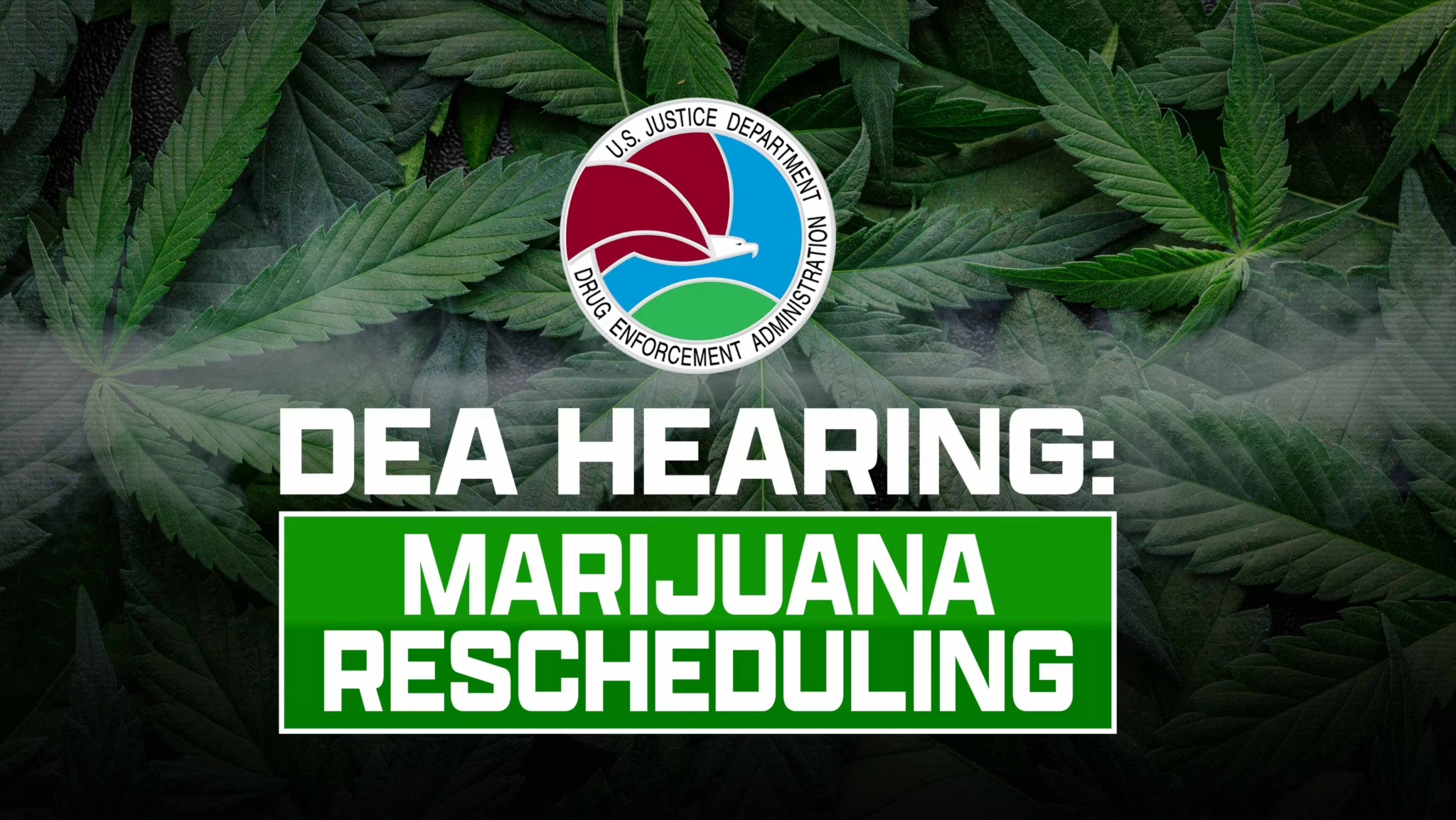
Days later, the administration signaled support for accelerated Schedule III marijuana reform following announcements from the Department of Justice and Attorney General leadership supporting the ongoing federal rescheduling process. The move comes ahead of the DEA’s highly anticipated June 29 hearing, where federal officials are expected to review testimony and recommendations tied to marijuana’s potential reclassification under the Controlled Substances Act. A final federal decision is widely expected before mid-July.
The change does not fully legalize cannabis federally, nor does it completely remove marijuana from the Controlled Substances Act. Recreational cannabis technically remains federally illegal.
However, the Schedule III shift dramatically changes the economics and legitimacy of the cannabis industry.
For years, cannabis businesses have been crushed by IRS Code 280E, a federal tax rule preventing marijuana operators from taking normal business deductions because cannabis remained classified alongside heroin and LSD as a Schedule I narcotic.
Schedule III changes much of that equation.
The move could:
expand medical cannabis research
reduce crushing tax burdens
attract institutional investment
improve banking confidence
accelerate pharmaceutical and FDA-backed cannabis studies
further legitimize state medical marijuana programs.
For cannabis investors, operators, and entrepreneurs, the White House developments signaled something even larger: the federal government may finally be entering the post-prohibition era.
For psychedelic advocates, the symbolism was equally staggering.
Only a few years ago, substances like psilocybin and ibogaine were politically untouchable in Washington. Now, discussions involving psychedelic therapies are taking place inside the Oval Office itself — backed by veterans groups, medical researchers, Silicon Valley investors, and some of the biggest podcast voices in the world.
Joe Rogan’s presence at the White House underscored how dramatically the cultural landscape has shifted.
What was once fringe counterculture conversation is now becoming federal policy discussion.
And while full federal legalization of marijuana has not yet occurred, many industry observers believe the combination of psychedelic reform, Schedule III cannabis reclassification, and mounting public support could represent the beginning of the largest American drug policy transformation since the Nixon-era War on Drugs began more than 50 years ago.
The federal government may have just signaled one of the biggest cannabis policy shifts in modern aviation history — and most travelers never noticed it.
In late April 2026, the Transportation Security Administration quietly updated its public-facing travel guidance to formally recognize “medical marijuana” as an item permitted in both carry-on and checked baggage under certain conditions. The change appeared on TSA’s “What Can I Bring?” database just one day before the Department of Justice’s revised Schedule III cannabis policy officially took effect nationwide.
While the update was not accompanied by a press release or public announcement, the timing has raised eyebrows across the cannabis industry, legal community, and medical marijuana markets.
The policy revision follows the Trump administration’s April 23 order signed by Acting Attorney General Todd Blanche, which moved state-licensed medical marijuana and FDA-approved cannabis medications from Schedule I to Schedule III under federal law.
That distinction matters.
For decades, cannabis was federally classified alongside heroin as a Schedule I narcotic — defined as having “no accepted medical use.” The new federal interpretation now acknowledges that state-regulated medical cannabis programs operate within a recognized medical framework, even if recreational cannabis remains federally prohibited.
The TSA’s updated language reflects that evolving federal posture.
According to the agency’s revised guidance:
“TSA security officers do not search for illegal drugs.”
The TSA also reiterated that its primary mission remains aviation safety and threat detection, not cannabis enforcement.
However, travelers should not mistake the update for full legalization.
The agency still warns that if TSA officers discover substances they believe violate federal or local law, the matter may be referred to law enforcement. The final decision at airport checkpoints still rests with individual TSA officers and local jurisdictions.
In practical terms, many cannabis patients and travelers say TSA has already taken a hands-off approach toward small personal-use quantities for years — especially in legal states. The new guidance appears to formalize that reality for state-licensed medical marijuana patients. Still, confusion remains.
The TSA policy does not clearly define quantity limits, documentation requirements, or how officers should verify whether cannabis products qualify under a state medical program. Critics say the federal government has effectively acknowledged medical cannabis without fully explaining how airports are supposed to enforce the distinction between legal medical products and federally prohibited recreational marijuana.
Legal experts continue to advise caution, especially when traveling across state lines or carrying larger amounts of flower, concentrates, or infused products. International travel with cannabis remains extremely risky regardless of state laws.
The broader cannabis industry is now watching the next major federal milestone: the DEA’s June 29, 2026 hearing on wider marijuana rescheduling. That proceeding could determine whether cannabis as a whole eventually moves into Schedule III — a shift that would dramatically impact banking, taxation, stock exchange access, institutional investment, and interstate commerce for the legal cannabis industry.
For now, the TSA’s quiet website edit may represent something larger than a simple travel policy update.
It may be the clearest sign yet that the federal government is slowly preparing the American public — and federal agencies themselves — for a post-prohibition cannabis era.
DEA’s June 29 Hearing Could Reshape the Future of Cannabis Capital Market
The cannabis industry is once again approaching a historic crossroads.
On June 29, 2026, the U.S. Drug Enforcement Administration (DEA) will begin a new administrative hearing to determine whether marijuana should broadly move from Schedule I to Schedule III under the Controlled Substances Act.
For decades, cannabis businesses have operated inside a bizarre legal contradiction: legal under state law in much of America, but still treated federally as a Schedule I narcotic alongside heroin. That classification has kept the industry trapped outside traditional banking, institutional investing, senior stock exchanges, and mainstream capital markets.
Now the federal government appears to be reconsidering that position.
In April, the Department of Justice and DEA already issued a major shift by moving state-licensed medical marijuana operations and certain FDA-approved cannabis products into Schedule III classifications under federal law.
But the June 29 hearing is potentially much bigger.
The key question now becomes:
Will the DEA finally abandon the long-held federal position that all marijuana commerce constitutes “drug trafficking” under federal law?
If that wall begins to crack, the financial consequences could be enormous.
Today, many major financial institutions remain cautious because cannabis businesses still trigger anti-money laundering compliance issues, Suspicious Activity Reports (SARs), and federal criminal exposure. Even publicly traded cannabis companies face limitations with institutional banking, lending, custody services, and access to major exchanges.
A broader Schedule III framework could begin changing that.
Industry analysts believe the biggest immediate impact may come through the removal of IRS Code 280E penalties, which currently prevent cannabis operators from deducting ordinary business expenses.
But beyond taxes lies the real long-term prize:
institutional capital.
If federal agencies such as FinCEN, Treasury, and banking regulators begin treating licensed cannabis businesses more like regulated industries instead of criminal enterprises, Wall Street may finally enter the sector in force.
That could eventually open the door for:
Senior exchange listings
Traditional lending
Institutional banking
Expanded venture capital access
Retirement and pension fund exposure
Broader custody and clearing support
Large-scale mergers and acquisitions
Interstate investment expansion
Some legal experts caution that Schedule III alone does not fully legalize recreational cannabis federally. Adult-use marijuana businesses would still exist in a gray zone unless Congress acts further.
Still, many insiders believe the June hearing represents the first serious federal discussion about collapsing the distinction between state medical and recreational cannabis markets.
If federally recognized medical cannabis becomes normalized inside regulated state systems, pressure will grow rapidly to treat licensed recreational operators similarly — especially in states where the same companies operate both systems side-by-side.
That possibility has investors watching closely.
For years, cannabis entrepreneurs have argued that the industry cannot mature while federal regulators continue labeling licensed operators as traffickers despite billions in state tax revenue and legal commerce.
The June 29 DEA hearing may determine whether Washington is finally ready to move cannabis from the shadows of prohibition into the framework of regulated American capitalism.
And if that happens, cannabis may stop being viewed as an underground industry — and start being treated like a legitimate American commodity market.
With the state’s flower ban looming in March, Texas hemp shop owners were staring at shelves full of products they suddenly might not be able to sell. Everyone was sweating – except AdamReposa.
The Austin attorney and owner of ATX Budtenders was unfazed, mostly because he’s been running a dispensary that technically sells “merch” and just happens to give away weed as a gift. He models his business after Washington DC-style dispensaries. In the nation’s capital, dispensaries dodge legal landmines by selling “services” like motivational speeches and then giving weed away as a “free gift.” Yes, that’s really the system. No, you’re not hallucinating.
ATX Budtenders leans into this model by selling t‑shirts priced from $100 to $300. If anything, Reposa admits he could be guilty of littering because his delivery drivers “toss weed into people’s yards” while dropping off shirts.
Winning in The Wreckage
The Texas Department of State Health Services’ smokable hemp ban isn’t its first attempt to choke out the industry. In 2021, the agency tried banning Delta 8 THC – a move the courts eventually put in time-out with a temporary injunction that’s still in effect five years later. In 2026, brands like Wyatt Purp sued again, hoping the Delta‑8 precedent would save them from another regulatory beatdown.
Meanwhile, Reposa’s business seems to enjoy protections that licensed flower dispensaries can only dream about.
Reposa has never depended on permission. He’s been selling his Mr. Chinga line of cannabis products for years, insisting Austin’s decriminalization efforts created a kind of de facto legalization – when the law says one thing, but everyday reality says another. In this landscape, ATX Budtenders continues to thrive, even after a January 2024 police raid that resulted in… absolutely nothing. More than two years later, no charges have been filed.
Whether he’s a visionary or a liability, Reposa’s presence makes one thing clear: Texas’ cannabis future won’t be shaped solely in courtrooms.
“They’re trying to hand the industry off to a bunch of rich people, and if we can’t win this fight, we’re f***ing losers,” Reposa said. “We’re just sitting around waiting for them to hand something to us, and that’s some pu**y ass bullsh*t if we let that happen. After all, we live in the land of ‘Come and Take it.’”
Entering a New Chapter – Personally and Professionally
At 50, Reposa is a recent divorcee who “hates dating apps and doesn’t feel bad about selling weed.”
“I’m not everyone’s cup of tea,” he said, while confirming a lack of emotional intelligence. “I’d be hard for any woman to handle. Maybe I’m not relationship material.”
Still, he’d like all the single ladies to know he’s on Tinder. Swipe responsibly.
Romance, however, is low on Reposa’s priority list. A looming hemp ban means an uptick in business for ATX Budtenders.
“My staff sucks, and I worry I’m not going to be able to keep up with my organic growth,” he said. “I need people who are worth a sh*t.”
Those who are interested in working at ATX Budtenders are encouraged to inquire by phone at 512-GAS-BUDS.
In addition to future hopes of running for Travis County District Attorney, Reposa aspires to make ATX Budtenders a nationwide brand.
“But it’s not going to be possible with my current dipsh*t staff,” he said.
This May or May Not End Well
Controversy is basically Reposa’s love language. He has been convicted of contempt of court twice, serving a collective 77 days in jail for the offenses. He has made antagonizing viral videos, and he once slapped stickers on East Austin businesses that featured the City of Austin’s seal and read, “Exclusively for White People,” to make a statement about gentrification. Subtlety is not his strong suit.
Launching ATX Budtenders fits neatly into his lifelong pattern of poking the bear. As legal hemp businesses face disruption from the state government, Reposa represents what everyone else is afraid to do. But is he exploiting the chaos or exposing the hypocrisy?
His business model may not survive forever, but for now, it exposes the strange limbo Texas has created – a place where enforcement is selective, legality is fluid, and the boldest players thrive in the cracks.
In a state at war with its own cannabis culture, Reposa is the wild card. And whether he’s right or reckless depends on who you ask.
Tommy Chong joins Blazed Weekly News for a conversation on cannabis, comedy, activism, pop culture, and a
lifetime of changing American history. From Motown to Cheech & Chong to the modern cannabis movement —
this is a legacy interview you don’t want to miss.Note:
I edited in some audio clips from their comedy albums that are not on the
original video episode below. Additionally the Audio here is also cleaned up better than
the video version so we can hear Tommy better.
After the interview: I explain since the recording began before the call started
i had not set the mix minus in the RCP2, so we had to hold the phone near the mic
to prevent a loop-feedback going back to an already hard hearing 88 Chong.
🙂 Enjoy this one guys because he was really comfortable and shares a lot this time.
Back in 1998, the Fox film The X-Files: Fight the Future used a fake “hantavirus” outbreak as the official government explanation for a deeper extraterrestrial crisis. In the film, FEMA becomes the public face of containment
while the real operation remains classified beneath the surface. It was classic X-Files: disease as cover story, federal agencies managing perception, and the public fed a safer narrative than the truth.
Now, nearly three decades later, hantavirus is suddenly back in headlines again amid renewed public anxiety after COVID. For conspiracy researchers and media skeptics, the timing revives an old question:
Did Hollywood merely imagine these scenarios — or are intelligence-linked institutions using entertainment to psychologically prepare the public for future crisis narratives?
This idea is commonly referred to as “predictive programming,” the theory that films, television, and pop culture introduce frightening concepts years before they emerge in real-world news cycles. The argument isn’t
necessarily that Hollywood predicts the future. Rather, critics suggest audiences become conditioned to emotionally accept certain emergency frameworks long before they happen.
And few television franchises embedded this idea deeper into American culture than The X-Files.
The show trained viewers to associate: pandemics with secrecy, FEMA with containment, science agencies with hidden agendas, and biological threats with government deception.
By the late 1990s, The X-Files had essentially merged Cold War paranoia with biotechnology fears and post-JFK distrust of federal institutions. After COVID-19, those themes no longer feel like fringe fiction to many Americans.
The broader conversation becomes even stranger when examining the long-documented relationship between intelligence agencies and the entertainment industry. The CIA has openly acknowledged historical cooperation with Hollywood productions and media consultants dating back to the OSS era.
Researchers have long argued that films and television can serve as soft psychological infrastructure: not necessarily direct propaganda, but narrative conditioning.
In that framework: alien invasions become metaphors for invisible threats, viruses become tools of social control, and emergency response agencies become symbols of centralized authority.
Then there’s the eerie overpopulation rhetoric that has circulated for decades among elite figures and global policy advocates.
One of the most infamous quotes often associated with this conversation comes from media mogul Ted Turner, who was repeatedly cited as advocating dramatically lower global population levels. Another widely circulated
quote — frequently misattributed online to Turner but actually linked to Prince Philip — stated: “In the event that I am reincarnated, I would like to return as a deadly virus…” The quote has appeared for years in discussions surrounding environmental extremism, depopulation fears, and elite technocratic ideology.
Whether these statements are taken literally, symbolically, or entirely out of context, they helped fuel public distrust during the COVID era — especially when combined with pandemic lockdowns, censorship debates, and rapidly shifting health directives.
That’s why the return of hantavirus headlines now hits a cultural nerve.
Because after COVID, Americans no longer watch outbreak stories the same way they did in 1998.
. . . as Hemp Industry Faces Regulatory Uncertainty
As Texas continues to battle over the future of smokable hemp and THCA flower, Blazed Magazine is officially expanding its distribution footprint into neighboring states including New Mexico and Oklahoma — a strategic move designed to protect advertisers, preserve audience growth, and continue serving cannabis consumers throughout the Southwest.
For years, Texas has been one of the nation’s most explosive hemp markets. But ongoing legal fights involving the Texas Department of State Health Services (DSHS), emergency injunctions, appeals, and shifting interpretations of THCA legality have created uncertainty for retailers, manufacturers, and media companies alike.
While the courts continue sorting out whether Texas regulators exceeded their authority with new hemp rules, publishers and cannabis brands are already adapting to the changing landscape.
That includes Blazed Magazine.
The publication, which originally built its distribution model around Texas smoke shops, dispensaries, CBD retailers, convenience stores, and cannabis culture events, is now investing heavily in regional expansion throughout New Mexico and Oklahoma. The move comes as Texas operators increasingly look westward toward more stable cannabis-friendly markets.
From Texas Uncertainty to Regional Opportunity
Texas hemp businesses have spent much of 2026 fighting regulatory whiplash. One week, courts temporarily block new DSHS rules targeting THCA flower and smokable hemp products. The next week, the State files appeals that throw portions of the market back into confusion. The legal battle intensified after DSHS attempted to implement stricter “total THC” calculations and dramatically increased licensing fees for hemp businesses. Industry groups argued the agency was attempting to rewrite Texas hemp law administratively after lawmakers failed to pass a full THC ban during the legislative session.
For publishers dependent on cannabis advertising revenue, the instability presents real business risks.
Instead of waiting for Texas politicians and courts to decide the industry’s fate, Blazed Magazine chose expansion.
The publication now promotes distribution across: Texas, New Mexico, Oklahoma. Combined, the network reaches more than 1,000 retail locations across the Southwest cannabis and hemp market.
New Mexico Becomes Key Growth Market
New Mexico has emerged as one of the strongest cannabis economies in the region since launching recreational marijuana sales in 2022.
Unlike Texas, New Mexico offers a fully regulated adult-use marijuana market with licensed dispensaries operating statewide. That creates a far more stable advertising and retail environment for cannabis-focused media brands. For Blazed Magazine, the New Mexico expansion provides several advantages: Access to licensed dispensaries and cannabis operators. Regional tourism traffic tied to legal cannabis.
Less dependence on Texas hemp politics. Additional print and digital advertising opportunities. Long-term audience growth beyond Texas restrictions.
The publication’s new distribution strategy includes major New Mexico markets such as Albuquerque, Santa Fe, Las Cruces, Roswell, Hobbs, Carlsbad, Clovis, Farmington, and surrounding rural communities.
Oklahoma Adds Massive Cannabis Reach.
Oklahoma also represents a major opportunity. Despite ongoing political debates over marijuana reform, Oklahoma still maintains one of the nation’s largest medical cannabis infrastructures with thousands of licensed operators statewide. Blazed Magazine’s Oklahoma expansion focuses on Tulsa, Oklahoma City, Norman, Broken Arrow, Stillwater, Ardmore, and numerous smaller regional communities connected to cannabis culture and Southwest tourism. The state’s mature dispensary network gives cannabis advertisers another stable regional outlet while Texas regulators continue redefining hemp compliance rules.
A Southwest Cannabis Media Network
The broader strategy behind the expansion is simple: Build a regional cannabis media network instead of relying entirely on Texas. That includes: Print distribution, Podcast integration, YouTube programming
digital banner advertising, social media campaigns, regional event coverage, and multi-state advertiser packages. The company’s Blazed Weekly News podcast and YouTube channel are also continue growing alongside the print expansion, helping advertisers maintain exposure even as regulations shift from state to state.
Texas Still Matters
Despite the expansion, Texas remains the core identity of the brand. The I-35 corridor from Austin to San Antonio continues to be one of the publication’s strongest distribution zones, with hundreds of active locations throughout Central Texas. But the reality is clear: Cannabis businesses can no longer depend entirely on Texas political stability. Until lawmakers create a coherent and consistent hemp framework, regional diversification may become the survival strategy for much of the Southwest hemp industry. And for Blazed Magazine, that future is already underway.
For distribution, advertising, or partnership information visit:
Blazed News • Watch Blazed Weekly News on YouTube: • Blazed Weekly News YouTube Channel
YouTube.com/@BlazedWeeklyNewz
Industry Awaits Emergency Relief from Appeals Court
The legal battle over Texas hemp products escalated again late Tuesday after the State of Texas officially filed its notice of appeal in the ongoing consumable hemp lawsuit, automatically staying the temporary injunction previously granted to the hemp industry.
In practical terms, the injunction is now lifted while the appeal moves forward — a move attorneys representing the hemp industry say they fully expected.
According to legal counsel involved in the case, attorneys have already alerted the 15th Court of Appeals that an emergency Rule 29.3 motion will be filed immediately upon assignment of a docket number.
The motion seeks temporary appellate relief that would effectively reinstate protections for Texas hemp businesses while the broader legal fight continues.
Industry attorneys say the filing will occur first thing Wednesday morning in hopes of minimizing disruption to operators, retailers, manufacturers, and consumers across Texas.
David Sergi Responds
Attorney David Sergi, representing the Harwin Union Council, released a public statement shortly after the State’s filing.
“We expected the State to appeal. We are confident that the 15th Court of Appeals will reinstate our Temporary Injunction so that our Vets, elderly, and adult consumers have reasonable access to these products. The voters will remember who voted for true liberty in November.” – — David Sergi
Sergi and other industry attorneys argue the new hemp restrictions would severely impact:
veterans using hemp-derived cannabinoids, elderly Texans seeking alternative wellness products, and licensed businesses operating under the federal hemp framework established after the 2018 Farm Bill.
Industry Braces for Another Legal Round
The appeal marks yet another dramatic turn in what has rapidly become one of the most closely watched hemp legal battles in the country.
The Texas hemp industry — estimated by advocates to generate billions in economic activity annually — has spent months battling proposed rules and enforcement efforts targeting: smoke-able hemp products, THCA flower, and consumable cannabinoid products.
Operators fear aggressive regulation could force many businesses to either close, relocate to states like New Mexico and Oklahoma, or transition into underground markets.
Meanwhile, critics of the hemp industry argue stronger oversight is necessary to address concerns regarding intoxicating hemp-derived products and consumer safety.
Appeals Court Now Holds the Key
Attention now shifts squarely to the 15th Court of Appeals, where hemp advocates hope emergency relief can be secured quickly enough to stabilize the market while litigation proceeds.
For Texas retailers and consumers, the next several days could prove critical. And for an industry already operating under enormous uncertainty, the legal war over hemp in Texas is far from over.
From Texas Uncertainty to New Mexico Opportunity — Blazed Moves West
As regulatory uncertainty continues to cloud the future of hemp and cannabis-derived products in Texas, Blazed Magazine is making a strategic move into one of the most stable and rapidly growing cannabis markets in the country: New Mexico.
With a fully legalized recreational cannabis program now entering its fourth year, alongside a long-standing medical marijuana program, New Mexico has emerged as a legitimate powerhouse in the Southwest cannabis economy.
According to the New Mexico Regulation and Licensing Department (NMRLD), total cannabis sales for March 2026 reached $48.1 million, including: $37.9 million in adult-use (recreational) sales $10.2 million in medical cannabis sales.
That breakdown reflects a consistent trend in the state: Approximately 77% recreational / 23% medical market share. Since launching recreational sales in April 2022, New Mexico has now surpassed $2 billion in total cannabis sales, with monthly averages holding steady near $47 million. This is no longer an emerging market—this is a mature, revenue-producing ecosystem.
A Strategic Expansion for a Changing Industry
Blazed Magazine, long known for its coverage of cannabis culture, policy, and industry trends across Texas, is expanding its footprint into New Mexico to better serve a growing base of cannabis businesses seeking stability, visibility, and market access. This move reflects a broader shift within the industry. As Texas regulators continue to evaluate new rules surrounding hemp-derived cannabinoids, THCA flower, and retail compliance, operators are increasingly looking toward neighboring states with clearer frameworks and long-term viability.
New Mexico offers:
A fully legal adult-use market
An active medical marijuana program
Strong and consistent monthly revenue
A rapidly expanding retail footprint
A welcoming environment for cannabis brands
Why New Mexico Matters Now
New Mexico’s cannabis industry is not speculative—it is proven, regulated, and growing.
Key advantages include:
$48M+ monthly sales volume
Dual-market strength (recreational + medical)
Over $2 billion in cumulative sales since 2022
Tourism-driven retail demand
Expanding dispensary network statewide
For brands looking to scale, New Mexico represents a balanced, sustainable market with both consumer depth and regulatory clarity.
Blazed Magazine offers a Platform Built for Cannabis Brands. With this expansion, Blazed Magazine is positioning itself as a multi-state media platform connecting cannabis businesses with engaged audiences across both Texas and New Mexico through; print distribution in high-traffic retail locations , digital publishing and web visibility, podcast and radio integration, social media amplification. Blazed also delivers multi-platform exposure in markets where visibility drives revenue. While publishing Texas Hemp Reporter in 2022, we placed a special edition of “MJ MONTHLY” all across New Mexico. While we only made one available during our trip to the Luck Leaf Expo in Albuquerque; we gained a valuable insight to the states distribution network, and shops and industry.
From Restriction to Opportunity
The contrast between Texas and New Mexico is becoming more pronounced.
In Texas:
Ongoing regulatory uncertainty around hemp-derived products
Increased scrutiny on THCA and retail compliance
An evolving and unpredictable legal landscape
In New Mexico:
Fully legalized adult-use cannabis
Established and regulated medical program
Stable monthly revenues exceeding $45M+
Clear operational guidelines for businesses
This divergence is driving a shift in attention, investment, and marketing dollars. It will be a new Chapter for Blazed. By expanding into New Mexico, Blazed Magazine is not leaving Texas—it is positioning itself at the intersection of two markets moving in opposite directions. For advertisers, this means: Access to two distinct but connected audiences, placement in a high-growth legal cannabis market, alignment with a publication rooted in cannabis culture and credibility.
The Bottom Line
The cannabis industry in the Southwest is evolving—and Blazed Magazine is evolving with it. New Mexico represents stability, growth, and opportunity. Texas represents potential, but uncertainty.
Perhaps Oklahoma will also present opportunities in the near future as well. Blazed is now positioned to connect brands with both. From uncertainty to expansion—this is where the next phase of cannabis growth begins.
The biggest day in federal cannabis policy in decades arrived this morning — and the fine print is doing a lot of work.
For years, cannabis advocates, industry operators, and policy watchers have dreamed of the day the federal government would move marijuana off Schedule I — off the shelf it shares with heroin, away from the company of substances deemed to have no accepted medical use and a high potential for abuse. Today, April 23, 2026, that day arrived. Acting Attorney General Todd Blanche signed the order. The DEA made it official. Cannabis, in limited form, is now a Schedule III controlled substance under federal law.
Savor the moment for a breath, and then read the fine print.
What moved to Schedule III is not cannabis as a category. It is not hemp-derived THC. It is not the THCA flower sitting in the case at your neighborhood smoke shop. It is not recreational marijuana, not CBD gummies, not delta-8 cartridges, not a single product in the vast and inventive gray market that has operated under the protective ambiguity of the 2018 Farm Bill. What moved to Schedule III is a carefully circumscribed set of products: FDA-approved drug formulations containing delta-9-THC derived from Cannabis sativa L., and marijuana subject to a qualifying state-issued medical marijuana license.
That’s it. That’s the win.
Everything else — and there is a great deal of everything else — remains Schedule I. Any marijuana product that is neither FDA-approved nor covered by a state medical license is still, under federal law, as illegal today as it was yesterday. The DOJ press release phrases this with lawyerly precision: the order applies to products “subject to a qualifying state-issued license authorizing the licensee to manufacture, distribute, and/or dispense marijuana or products containing marijuana for medical purposes.” The recreational market in legal states? Still Schedule I. The hemp-derived THC products that have carved out a multi-billion dollar niche in the regulatory gray zone? Still Schedule I. Still, potentially, federal felonies.
This distinction is not incidental. It is the architecture.
To understand why, you have to appreciate who benefits from today’s order and who does not. The clear winners are the multi-state operators — the MSOs that have spent years building licensed, regulated, vertically integrated cannabis businesses in states that permit medical use. These companies have labored under Section 280E of the Internal Revenue Code, a provision that denies standard business deductions to enterprises trafficking in Schedule I or II substances. Moving to Schedule III eliminates that burden, potentially freeing up tens of millions of dollars in annual tax liability for the larger operators. It also accelerates federally permitted research, clears a path for banking relationships long denied to Schedule I businesses, and, less tangibly but not insignificantly, removes some portion of the stigma that has clung to the industry like smoke to fabric.
The losers are the hemp-derived THC operators — the manufacturers, distributors, and retailers who have built businesses on the premise that Farm Bill hemp, with its permissive treatment of cannabinoids other than delta-9, created a lawful pathway to the intoxicating cannabis market. Today’s order does not validate their business model. If anything, it sharpens the line of demarcation between the licensed, legitimate cannabis industry and what the MSOs have long called the gray market — and have more recently started calling an unlawful competitor.
Consider the sequence. For the past two years, multi-state operators have been suing smoke shops and distributors across the country — in Missouri, Pennsylvania, and Texas among other states — arguing that hemp-derived THCA products are functionally marijuana and should never have been sold under Farm Bill cover. Today’s rescheduling order hands those operators a cleaner rhetorical weapon. If you want the protection of federal tolerance, get a state medical license. If you don’t have one, the federal government has just made its position more explicit, not less.
The order was signed by Todd Blanche, the acting attorney general, and it comes roughly four months after President Trump’s executive order directing the administration to move forward on rescheduling — a process that had languished through years of NPRM proceedings, administrative hearings, and public comment periods under the previous administration. That the Trump DOJ completed the move, however narrowly scoped, is genuinely notable. It is not the comprehensive reform that advocates sought, but it is a real policy change with real economic consequences for a real industry.
The next inflection point is June 29, 2026, when the DEA has announced it will convene an expedited hearing to consider whether marijuana as a category — not just the FDA-approved and state-licensed subset — should be reclassified to Schedule III as well. That hearing is where the broader argument will be fought. It is where the hemp industry will have to confront the question it has largely avoided: if marijuana moves to Schedule III wholesale, does the Farm Bill gray zone collapse entirely, or does it survive through a different legal theory?
No one has a clean answer to that question yet, which is precisely why it’s the most important question in cannabis policy right now.
What we know today is this: the federal government drew a line, and it drew that line around the licensed medical market. THCA is on the wrong side of it. Hemp-derived intoxicants are on the wrong side of it. The gray market — creative, entrepreneurial, constitutionally interesting, and genuinely beloved by the consumers it serves — just got a clearer target on its back.
That’s not a reason to despair. It’s a reason to pay very close attention to what happens on June 29.
Jay Maguire covers cannabis policy, hemp industry litigation, and the politics of drug reform. He is political editor of a cannabis industry trade publication and an investigator working on behalf of hemp retailers and distributors in regulatory and legal proceedings.
There is a particular kind of regulatory failure that does not arrive with subpoenas or headlines. It slips in quietly, dressed up in spreadsheets and procedural language, hiding in a denominator that nobody bothers to question. It looks clean, professional, even defensible—right up until someone actually runs the numbers.
That is precisely what has happened in the Texas Compassionate Use Program expansion under House Bill 46. The Department of Public Safety published a scoring rubric that promised a simple, balanced framework: four categories, each carrying equal weight. What the State implemented was not that framework. It was something materially different, and the difference is not philosophical or interpretive. It is mathematical, and it changed who won.
The Rule the State Published
DPS told applicants, in plain English, that four categories would each account for 25 percent of the final score. Those categories—Security and Infrastructure, Accountability, Financial Responsibility, and Technical and Technological Ability—were presented as equal partners in the evaluation process.
There was nothing subtle about that promise. It was repeated in the rubric, relied upon in applicant preparation, and understood as the governing structure of the competition. Four equal slices of the pie, adding cleanly to one hundred percent. That is the rule applicants were told they were competing under.
The Structure Beneath the Rule
Beneath that clean promise, however, sat a more complicated reality. Each category contained a different number of scoring items. Security and Infrastructure included fourteen separate elements. Accountability included twelve. Financial Responsibility included eight. Technical and Technological Ability, the category that speaks most directly to whether an operator can actually run a compliant medical cannabis program, included just four.
Each of those items was scored by three evaluators on a scale of zero to five hundred. That structure produces dramatically different raw scoring ceilings. A perfect score in Security and Infrastructure reaches twenty-one thousand points, while a perfect score in Technical and Technological Ability tops out at six thousand.
There is nothing inherently improper about uneven category sizes. Any seasoned regulator or procurement officer has seen rubrics where some sections are more granular than others. The critical requirement, and the one that determines whether the system is fair, is normalization. If the State promises equal weighting, then each category must be scaled to ensure it actually contributes equally, regardless of how many individual items it contains.
What Equal Weighting Actually Requires
If you want four categories to count equally, the math is straightforward. You do not sum raw totals. You convert each category into a percentage of its own maximum possible score. Once each category is expressed as a percentage, you then apply equal weighting across those percentages.
In practical terms, that means taking an applicant’s score in each exhibit, dividing it by that exhibit’s maximum possible score, and then weighting each result at twenty-five percent. When you add those four weighted values together, you get a final score that reflects the rule the State said it would follow.
This is not exotic mathematics. It is standard practice across regulated industries, procurement systems, and competitive licensing frameworks. It is how you translate unequal components into equal influence.
What the State Actually Did
Instead of normalizing each category to its own maximum, DPS applied a single divisor across all four exhibits. Every raw score, regardless of whether it came from a category with fourteen items or one with four, was divided by twelve.
At first glance, that may look like a harmless simplification. It is not. When you divide unequal totals by the same number, you do not equalize them. You preserve their imbalance and carry it forward into the final score.
The result is a set of “Applicant Scores” that look standardized but are anything but. Security and Infrastructure retains a ceiling of 1,750 points, while Technical and Technological Ability is capped at just 500. When those numbers are combined, the weighting shifts dramatically. Security and Infrastructure ends up driving roughly thirty-seven percent of the final score. Accountability contributes about thirty-two percent. Financial Responsibility falls to roughly twenty-one percent. Technical and Technological Ability, the category that should stand shoulder to shoulder with the others, is reduced to just over ten percent.
That is not a rounding discrepancy or a clerical oversight. That is a complete reweighting of the system the State said it was using.
Why This Is Not a Close Call
There is no gray area here. Dividing unequal numbers by the same constant does not normalize them. It preserves their proportional differences. A category with a maximum score of twenty-one thousand will remain three and a half times more influential than a category capped at six thousand if both are subjected to the same divisor.
This is arithmetic, not interpretation. Once the method is set, the outcome follows automatically. The State did not accidentally drift away from equal weighting. It implemented a formula that could never produce equal weighting.
The result is that the rule applicants relied upon and the method used to evaluate them are not the same.
This Was Not an Isolated Mistake
If this were a one-off inconsistency buried in a single application, it might be dismissed as a transcription error. It is not. A review of virtually every scoring entry across both phases of the licensing process shows the same method applied without exception. Raw totals were divided by twelve, and those results were summed to produce final rankings.
This was the system. It was applied consistently. It was just not the system the State said it would use.
What Happens When You Fix the Math
When the applications are recalculated using the correct method—normalizing each category to its own maximum and then weighting them equally—the rankings change in ways that matter.
The very top of the list remains relatively stable. Companies that performed well across the board continue to perform well. The disruption occurs in the middle tier, where licenses are actually awarded.
Under the corrected calculation, three companies that received conditional licenses fall out of the top twelve. In their place, three different applicants move into winning position. Those new entrants are Texas-based operators who performed exceptionally well in Technical and Technological Ability, the very category that was most heavily discounted under the State’s method.
What emerges is not randomness or noise. It is a clear pattern. The flawed formula elevated categories with more scoring items—primarily infrastructure—and suppressed the influence of technical competence. When you restore the intended weighting, applicants who excelled in technical execution rise accordingly.
Why This Matters Beyond the Applicants
It is tempting to treat this as a dispute between competing companies, but that framing misses the point. Every license issued under this system determines where dispensaries are built, which companies invest capital in Texas, and how patients access medical cannabis.
For nearly a decade, Texas operated with just three dispensing organizations serving a vast and geographically dispersed patient population. House Bill 46 was supposed to correct that imbalance and bring the program into alignment with the needs of the state.
If the licensing process that governs that expansion is built on a misapplied formula, the consequences are not abstract. They are felt in the placement of facilities, the availability of products, and the ability of patients to obtain treatment without driving across half the state.
This is not a paperwork problem. It is a capacity allocation problem with real-world effects.
The State’s Position and Its Exposure
The State represented to applicants that each category would carry equal weight. Applicants relied on that representation in structuring their submissions. That reliance is not incidental; it is the foundation of the competitive process.
When the implemented methodology diverges from the published rule, the issue moves beyond process into legitimacy. The State is no longer simply defending a policy choice. It is defending a result that does not align with the rule it set.
That is a difficult position to maintain, particularly in a regulated industry where credibility is currency. Every future licensing decision, every enforcement action, and every legislative hearing will be measured against whether the State followed its own rules here.
Author’s Note:
This article has been revised to more clearly present the scoring calculations underlying the Texas Compassionate Use Program licensing process. The updates expand the mathematical explanation and align the analysis with the methodology described in the State’s published rubric.
A Strange Connection: Judge Maya Guerra Gamble, Alex Jones, and the Texas Hemp Industry
By Russell Dowden
Publisher, Blazed Magazine / Texas Hemp Reporter
There are moments where media, law, and industry collide in ways that feel almost pre-written. For me—and for Judge Maya Guerra Gamble—those intersections have happened more than once, each time with real consequences.
From Infowars to HBO: A Shared Timeline
In HBO’s “The Truth vs. Alex Jones,” I appear in the opening minutes, providing context on Alex Jones’ early days in Austin media. In 2012, I served as General Manager of Infowars Magazine, working inside the ecosystem that would later become the center of a landmark defamation case.
That case ultimately landed in Judge Gamble’s courtroom.
The $49 Million Judgment
In November 2022, Judge Gamble upheld a Texas jury’s award of roughly $49 million in damages against Alex Jones in the Sandy Hook case. It was a defining moment for media accountability—and a surreal one for those of us who had once worked in that orbit.
The Sweet Sensi Case: Where It Got Personal
The next intersection wasn’t just professional—it became personal.
During the Sweet Sensi litigation, my publications—Texas Hemp Reporter and related titles—were entered into evidence by both legal teams during discovery. That’s rare air for a publisher: not just covering a case, but becoming part of the record.
Both the plaintiff and defendant were active advertisers, and coverage of the dispute became a focal point in how the case was perceived publicly.
Tensions escalated beyond the courtroom.
On October 25, 2024, Greg Autry of Sweet Sensi ran a paid advertisement in The Austin Chronicle that directly attacked Wyatt Larew of Wyatt Purp and the Texas Hemp Reporter. It was a public shot—aimed not just at a competitor, but at our coverage.
The verdict changed that narrative.
A Texas jury ultimately found constructive fraud and other violations against Sweet Sensi—effectively vindicating Wyatt Larew and the Texas Hemp Reporter’s initial reporting on the case.
For us, it wasn’t just a legal outcome—it was validation.
Back in Court: The Fight for THCA Flower
Now, in 2026, Judge Gamble is again presiding over a case with major implications for Texas hemp.
With THCA flower representing roughly 50% of hemp product sales, the current litigation could determine the industry’s future.
So far, Judge Gamble has:
Granted a Temporary Restraining Order (TRO)
Allowed continued sales of THCA flower—for now
Set a Temporary Injunction Hearing for Friday, April 23 at 9 AM
That hearing is expected to be pivotal.
It could decide:
Whether THCA flower remains legal in Texas
How aggressively the state can regulate hemp moving forward
Whether small operators survive the next phase of enforcement
A Pattern of Consequence
Across three very different cases, a pattern emerges:
Alex Jones → financial accountability at scale
Sweet Sensi → industry-level precedent and media scrutiny
THCA litigation → the future of hemp commerce in Texas
And in each instance, Judge Maya Guerra Gamble has been at the center.
A Publisher in the Crosscurrents
From appearing in an HBO documentary about Alex Jones…
To having my magazines entered into court as evidence…
To now covering—and being part of—the ongoing fight over hemp…
This isn’t just reporting from the sidelines.
It’s being in the middle of it.
What Happens Next
All eyes are now on the April 23rd injunction hearing.
What’s decided in that courtroom could:
Reshape the Texas hemp market
Determine the fate of THCA flower
And once again place Judge Gamble at the center of a high-impact ruling
There are moments in a policy fight when the noise stops working—when all the bluster, press conferences, and scare tactics run headlong into a judge who doesn’t care about any of it and just asks one simple question: what does the law actually say?
April 10 was that moment.
What followed was less a legal argument than a slow-motion collapse. The State’s lawyer looked like a man who brought a water pistol to a cattle drive—outmatched, outgunned, and increasingly aware of it. As the court pressed in, the case didn’t just weaken, it unraveled, failing the most basic requirement of any courtroom: say something with a straight face and back it up.
They couldn’t.
Because when it came down to brass tacks, the trifecta wasn’t even close. The facts weren’t on their side. The statute wasn’t on their side. And the Constitution sure as hell wasn’t on their side.
And a Texas judge noticed.
April 10, 2026 is going to stick. Not because it ends the fight, but because it exposed it. Strip away the politics, put the argument under oath, and the prohibitionist case folded like a cheap lawn chair in an August heatwave.
They didn’t just lose.
They got their hat handed to them.
A Travis County district court issued a Temporary Restraining Order halting enforcement of Texas’ latest hemp rules — a sweeping regulatory scheme that, in plain terms, attempted to rewrite the law without bothering to ask the Legislature. For an industry that has spent years navigating shifting goalposts, administrative improvisation, and the occasional outbreak of outright hostility, this order lands not merely as a procedural win. It’s a judicial rebuke — precise, methodical, and rooted in the first principles of administrative law.
What the State Tried to Do
The core issue, stripped of regulatory camouflage, couldn’t be simpler. Texas law defines hemp using a delta-9 THC concentration threshold of 0.3% on a dry weight basis. That’s the statute. That’s the line the Legislature drew. What DSHS attempted was to swap that framework for a “total delta-9 THC” or “acceptable hemp THC level” standard — a different chemical metric, a different legal universe, achieved entirely through rulemaking.
The court saw through the maneuver immediately. The rules, it found, “effect a substantive change in the governing law through rulemaking rather than implementing the statute as written.” That’s not a technical infraction. That’s a separation-of-powers problem — the kind courts take personally. Agencies are creatures of statute. They implement the law. They don’t rewrite it because they’ve decided they’d prefer a different answer.
Why the Court Moved Immediately
Temporary restraining orders don’t come easy. The standard demands a showing of probable success on the merits and imminent, irreparable harm. The plaintiffs cleared that bar with room to spare.
Enforcement of these rules, the court concluded, would fracture the entire hemp supply chain — manufacturing, testing, transport, retail — and effectively force businesses to shut down, abandon Texas, or face enforcement actions tied to standards no legislature ever authorized. The harm here isn’t hypothetical; it’s operational collapse. Supply chains break. Customer relationships vanish. Goodwill, once gone, doesn’t file a refund claim. These aren’t losses that can be tabulated and made whole later. They’re structural — and that’s precisely why the court found them irreparable.
A Statewide Industry, Not a Niche Dispute
One of the ruling’s more consequential passages is its recognition of scope. Processors, manufacturers, distributors, and retailers all operate within the same regulatory ecosystem. A flawed rule doesn’t stay politely contained — it propagates. Limiting relief to the named plaintiffs would have been a legal gesture, not a remedy. Effective relief required restraining enforcement broadly against similarly situated businesses, and the court said so plainly.
That finding matters beyond the immediate case. It signals that the judiciary understands the scale of what’s at stake here and isn’t prepared to treat a statewide industry like a zoning dispute.
The Public Interest Argument They Didn’t Expect to Lose
Perhaps the most quietly devastating section of the order is its treatment of the public interest — the argument opponents of the hemp industry have been running for years as if it were their exclusive franchise.
The court declined to rent it to them.
Instead, it recognized that consumers across Texas rely on hemp-derived products for legitimate, documented purposes: chronic pain, PTSD, sleep disorders, and as alternatives to alcohol and pharmaceuticals that carry their own considerable risks. Many of those consumers are veterans. The court also acknowledged what any honest policy analyst already knows: removing lawful products from the market doesn’t extinguish demand. It reroutes it — toward less regulated, less safe, or outright illicit alternatives. That’s not an industry talking point. That’s a judicial finding, and it will be difficult to walk back.
What the TRO Actually Does
The order is operational, not symbolic. The state is now restrained from enforcing the rules’ substitution of a “total THC” standard for the statutory delta-9 threshold, along with the enforcement mechanisms dependent on that framework — penalties, product embargoes, and license actions built on provisions the Legislature never passed.
The practical effect is a restoration of the status quo ante — the regulatory environment as it existed before March 31, 2026. Not perfect rules. Not permanent rules. Lawful ones. And for now, that’s enough to keep an industry running.
What Comes Next
A hearing on a temporary injunction is set for April 23, 2026, where the legal questions will be litigated more fully and the state will have its opportunity to defend the rulemaking. But the trajectory is already legible. The court has signaled skepticism grounded in statutory interpretation and administrative law doctrine — skepticism the state will struggle to overcome without retreating from its current position.
The strategic lesson here is simple enough. When the political process gets captured by narrative, the legal system becomes the venue of last resort. When the record is strong — when the facts, the statute, and the economic realities align — courts still function as a corrective. There’s a durable tendency in Texas politics to treat enforcement power as though it were synonymous with legal authority. This order draws a bright line between the two.
The state can regulate hemp. What it cannot do is redefine it. That distinction now sits where it always belonged: in the hands of the Legislature, not in the hands of whoever is running the rulemaking process on any given Tuesday.
A new lawsuit alleges Ohio used definitional trickery, interstate discrimination, and possibly an invalid veto process to hand a lawful hemp market to in-state marijuana licensees.
There are only so many ways a government can say, with a straight face, that it supports “regulation” while using the machinery of the state to crush lawful competition and reward politically favored insiders.
Ohio may have just found a new one.
A newly filed lawsuit by North Fork Distribution I, LLC, which does business as Cycling Frog, alleges that Ohio Senate Bill 56 does not merely regulate hemp. It effectively converts federally lawful hemp products into “marijuana” under Ohio law unless they are cultivated, processed, and sold through Ohio’s licensed marijuana system. In plain English, the complaint says Ohio tried to use state law to wall off its market, criminalize ordinary interstate commerce, and give the spoils to existing in-state marijuana operators.
That is not sound policy-making. That is market allocation with a badge and a press release.
The central allegation is straightforward. Congress legalized hemp in the 2018 Farm Bill and protected its interstate transportation. Ohio, according to the complaint, responded by narrowing the state definition of “hemp” so aggressively that many federally lawful hemp-derived products would be treated as “marijuana” once they enter Ohio. The result, the plaintiff argues, is that out-of-state hemp businesses face potential criminal exposure while Ohio’s licensed marijuana businesses receive an exclusive commercial advantage.
And the most revealing evidence may not be in the rhetoric of the complaint at all. It is in the state’s own legislative paper trail.
An attachment to the filing includes the Ohio Legislative Service Commission’s “Synopsis of Conference Committee Amendments,” which states that products falling outside the narrowed hemp definition “will be considered marijuana and sold exclusively in marijuana dispensaries.” That language is politically devastating because it strips away the usual camouflage. This was not merely about labeling, testing, or age gates. According to the complaint and the attached synopsis, Ohio structured the law so that products excluded from the new hemp definition would not disappear from commerce altogether. They would be redirected into a protected channel: licensed marijuana dispensaries.
That is the kind of detail that matters. It tells you what the law does, who it benefits, and who gets shoved overboard.
The lawsuit raises two major constitutional claims. First, it argues that S.B. 56 violates the Dormant Commerce Clause by discriminating against interstate commerce and favoring Ohio’s in-state marijuana industry over out-of-state hemp operators. Second, it argues that the law is preempted by federal law because Congress expressly protected the interstate transportation of hemp and removed hemp from the federal controlled-substances framework. Ohio, the complaint says, cannot simply relabel federally lawful hemp as “marijuana” at the border and pretend the Supremacy Clause does not exist.
That alone would make this an important case. But the complaint goes further.
It also alleges that S.B. 56 was never validly enacted in the first place because Governor Mike DeWine purportedly used the line-item veto in a manner forbidden by the Ohio Constitution. The filing contends that the governor did not merely veto appropriations items. He instead struck substantive policy language and tried to condition approval of the bill on that basis. If true, that is not a hemp technicality. That is a separation-of-powers problem. It means the case is not just about cannabinoid policy. It is about whether a governor can rewrite legislation under the guise of veto authority.
The complaint also does what strong injunction pleadings are supposed to do: it ties the constitutional injury to real-world harm. Cycling Frog’s verification affidavit says the company has substantial Ohio sales, inventory, contracts, retail relationships, and sunk investment tied to the market, and that it stands to lose a significant share of its business if the law takes effect. The company alleges that it cannot practically continue operating in Ohio without risking prosecution once federally lawful products are reclassified by Ohio as “marijuana.”
That matters because this is where many state officials and industry opportunists play games. They talk as though hemp operators are abstract villains and every product is a policy thought experiment. But companies are making payroll, signing leases, building supply chains, and operating in reliance on federal law and existing state frameworks. When a state abruptly rewrites definitions to favor a politically connected channel, the damage is not theoretical. It is immediate, concrete, and often irreversible.
This is why stakeholders in Texas should pay very close attention.
The tactic on display in Ohio will look familiar to anyone who has watched the hemp wars in other states. First comes the moral panic. Then the selective outrage. Then the carefully staged media narrative about “intoxicating hemp” destroying civilization. Then, once the public is softened up, comes the real play: not a neutral safety framework applied evenly across markets, but a commercial carve-up that favors incumbent interests and punishes disfavored ones.
That is what makes this case larger than Ohio.
If a state can redefine lawful hemp into contraband whenever the category becomes economically inconvenient, then the 2018 Farm Bill means whatever a hostile bureaucracy says it means that week. If a state can criminalize out-of-state products while granting in-state licensees exclusive control of the same market, then “regulation” has become a euphemism for economic protectionism. And if governors can carve up substantive law with an improvised theory of veto power, then the constitutional structure itself becomes just another casualty of the culture war.
There is also a political lesson here that the hemp industry needs to learn, and learn fast.
The people trying to destroy this market are rarely content with honest argument. They do not merely say they prefer a different regulatory structure. They inflate, smear, panic, and posture. They wrap commercial self-interest in the language of safety and then dare anyone to notice the transfer of wealth and power underneath. That game works only as long as no one reads the bill language, the committee synopsis, the enforcement hooks, and the market consequences together.
This lawsuit does exactly that.
It forces the question that every honest regulator should have to answer: if your concern is truly public safety, why are the products not banned across the board? Why are they being shifted into a preferred in-state system? Why do existing licensees get protection while interstate competitors get prosecution risk? Why does the law read less like a neutral regulatory framework and more like a franchise agreement for politically approved sellers?
Those are not rhetorical flourishes. They are the questions at the center of the case.
Ohio will, of course, say this is about health and safety. States always do when they are caught red-handed building a moat around favored economic actors. Courts will have to decide whether that explanation survives scrutiny. But on the face of the complaint, this is not a frivolous challenge or a performative filing. It is a serious constitutional case backed by a legislative paper trail and a concrete injury record.
National operators, retailers, compliance professionals, litigators, and investors should watch this closely. So should every Texas stakeholder who still thinks these state fights are isolated skirmishes. They are not. They are part of a coordinated pattern in which lawful hemp is tolerated when it is politically weak, demonized when it grows, and targeted for absorption or elimination when entrenched interests decide the market has become too valuable to leave alone.
That is the broader truth.
The fight is no longer just over cannabinoids. It is over whether law means what it says, whether interstate commerce still exists when a hostile state dislikes the product category, and whether politically disfavored businesses have any protection against governments that rewrite definitions to achieve outcomes they cannot defend openly.
The State Tried to Rewrite the Law Without Passing One
Filed tonight in Travis County, the hemp industry’s lawsuit against Texas regulators is not a routine administrative skirmish. It is a direct challenge to one of Austin’s most corrosive habits: when the Legislature declines to act, agencies act anyway.
That is the allegation — not as rhetoric, but as an unconstitutional structure the court must toss out like a drunk politician from The Cloak Room bar at last call.
To understand how Texas arrived at rules the legislature specifically declined to pass, you have to understand how power actually flows in Austin — and why that flow is far more complex, and far more lopsided toward one office, than most observers outside the Capitol appreciate.
The plaintiffs — trade associations, manufacturers, retailers — are not asking the court to referee competing visions of hemp policy. They are asking a more fundamental question: who governs? Because the constitutional process already answered it.
The Legislature passed Senate Bill 3. The Governor vetoed it. Two special sessions failed. Under the Texas Constitution, that means no new law. Full stop.
And yet, through rulemaking effective March 31, 2026, state agencies imposed the very restrictions the Legislature had declined to enact. The lawsuit is the industry’s answer to that maneuver. To understand why it happened, you need to understand the men behind it — and the institutional machinery one of them has spent eleven years building.
Because Dan Patrick has spent the better part of six years trying to destroy 8,500 licensed businesses, 53,000 jobs, and a $4.3 billion industry that the Legislature created, the Governor preserved, the courts protected, and the overwhelming majority of Texans want to keep — which raises the uncomfortable question of exactly whose Texas he thinks he’s governing.
The Most Powerful Man in Austin You’ve Never Fully Reckoned With
Most people understand that the lieutenant governor presides over the Texas Senate. What they don’t understand is what “presides” actually means in practice.
The man who once tossed THC gummies and cereal bites at reporters like a deranged game show host, then declared that regulated hemp shops were somehow a greater threat to Texas families than the opioids legally dispensed on every corner, has now — having failed four times through the front door — sent his agencies in through the window to do what democracy wouldn’t.
Under Senate rules, the lieutenant governor appoints every committee and every committee chair, refers all legislation to committee, controls the order in which bills come to the floor, and rules on all parliamentary questions at his own discretion. Bills don’t advance because they have the votes. They advance because Dan Patrick allows them to advance. The power of recognition is the power of life and death over legislation, and Patrick has exercised it without apology or restraint since taking office in 2015.
He has gone further than any of his predecessors were willing to go. Soon after assuming office, he persuaded the Senate to drop the threshold needed to consider a bill from two-thirds to three-fifths — a procedural change his predecessors Perry and Dewhurst never attempted because, as one political scientist put it, they had to work with senators on both sides. Patrick had no such compunction. He remade the chamber in his image. He then did something genuinely extraordinary in Texas political culture: he actively endorsed candidates in Republican Senate primaries — building a caucus that is not merely conservative but personally loyal to him, senators who owe their seats, in part, to his imprimatur.
But the lever most people miss entirely is Sunset.
The Texas Sunset Advisory Commission reviews state agencies and recommends to the legislature whether they should survive, be restructured, or disappear. In most cases, agencies are automatically abolished unless legislation is enacted to continue them. The lieutenant governor appoints half the Senate membership of that commission. Every agency director in Texas — every commissioner, every executive — knows that the man presiding over the Senate controls a significant portion of the body that can recommend their agency’s abolition. This is not a subtle pressure. It is an existential one. Agency heads who cross Patrick don’t just face legislative headwinds. They face the prospect of their agency’s continued existence becoming a question mark at the next Sunset cycle.
DSHS is not exempt from this calculus. In fact, it is deeply embedded in it.
Political scientists who study Texas government have noted that the lieutenant governor is considered as powerful as, and sometimes more powerful than, the governor. That assessment, already striking in the abstract, becomes clarifying when applied to the hemp saga — because the entire story of how we got to March 31 is, at bottom, the story of what happens when those two centers of gravity collide.
A Decade of Managed Coexistence, Then a Public Break
For most of their overlapping tenures, Abbott and Patrick maintained a working relationship premised on ideological alignment and careful avoidance of head-on collision. They are different creatures. Abbott is the cautious institutionalist — a former Texas Supreme Court justice who thinks in terms of legal sustainability, constitutional exposure, and long-game political risk management. Patrick is the former radio talk show host and Tea Party insurgent who thinks in terms of political dominance, culture-war momentum, and the next morning’s headlines. They needed each other and mostly behaved accordingly.
Hemp shattered that arrangement with unusual and very public ferocity.
Patrick had made SB 3 his signature priority of the 2025 session — a comprehensive ban on consumable hemp products containing THC. The Senate passed it 30 to 1 in March. He had staked his institutional credibility on it, worked his caucus, and by all accounts believed he had the governor’s quiet assurance that the bill would be signed. Then, just minutes before the veto deadline, Abbott killed it — without even calling Patrick first.
Patrick’s account of their private conversations was specific and damning. He claimed the governor had told him personally, in front of witnesses, “don’t worry about the bill” and had even asked Patrick’s staff lawyers for arguments he could use when signing it. Abbott’s team declined to engage the substance of those claims, which was itself a kind of answer.
The public rupture was immediate and raw. Patrick accused Abbott of wanting to “legalize recreational marijuana in Texas.” He held a press conference in which he described the governor’s late-night veto as a betrayal, questioned where Abbott had been all session, and demanded to know what had changed. It was the kind of performance that plays well on talk radio — which is, after all, where Patrick spent most of his adult life learning how to work a crowd. Abbott, operating in his natural register, issued a veto message that read like a legal brief: constitutional vulnerability, the Arkansas precedent where a similar ban had been enjoined in federal court for nearly two years, economic harm to tens of thousands of Texans who had invested in good faith under existing law.
Two men, two completely different concepts of what governance is for.
Abbott called two special sessions. Patrick refused to pivot toward regulation in either of them, driving legislation in both that mirrored the original ban. The Legislature sent Abbott nothing he could sign. At which point Abbott did what executives do when legislatures fail — he acted unilaterally, issuing Executive Order GA-56 on September 10, 2025, directing DSHS, TABC, and DPS to implement safety regulations: age verification, mandatory testing, labeling requirements, child-resistant packaging, enforcement coordination.
It was careful. It was targeted. And it was, critically, considerably less than what DSHS actually did with it.
The Technical Pivot That Changes Everything
At the center of the lawsuit sits what looks, at first glance, like a technical adjustment — a shift from a delta-9 THC standard to a “total THC” calculation.
It is anything but technical.
Texas law is explicit: hemp is defined, and legalized, based on delta-9 THC concentration not exceeding 0.3 percent. The Legislature chose that metric deliberately and wove it throughout the statutory framework governing commerce, testing, and legality. The new rules retain that definition on paper. Operationally, they replace it.
Regulators now mandate compliance with a formula that converts THCA into delta-9 THC equivalents — expanding the definition of “illegal” without touching the statute. Products lawful under the law become unlawful under the rule. That is not implementation. That is substitution. And in Texas constitutional law, those are very different things.
GA-56 authorized safety measures. It did not authorize a rewrite of the THC testing standard. It did not direct DSHS to adopt a total THC calculation that includes THCA — which has the practical effect of banning the majority of the hemp market that the Legislature had repeatedly declined to ban. That decision was DSHS’s own.
Which brings us back to Patrick, and to Sunset, and to the institutional ecosystem in which DSHS makes its decisions.
The agency didn’t go beyond GA-56 because Abbott told it to. DSHS went beyond GA-56 because it exists in a political environment where the most powerful actor in the building that controls its continued existence had made unmistakably clear what outcome he wanted. Patrick hadn’t merely lost a vote. He had been publicly humiliated by the governor, his signature priority killed in the final minutes of the session. Every career official in Austin understood the temperature.
The total THC formula was the only rulemaking decision that could simultaneously satisfy a governor’s executive order — technically, with careful reading — and deliver substantively the outcome the lieutenant governor had demanded and failed to get through the front door of the legislative process. DSHS chose the formula that closes the market. The rules effectively implement a federal total THC standard eight months ahead of the federal deadline, without the Texas Legislature having adopted that standard through statute. That tells you everything you need to know about whose clock the agency was watching.
A Regulatory Scheme That Collapses the Market
The complaint catalogs, in granular and unsparing detail, how these rules function in practice. The cumulative effect is not incremental regulation. It is market elimination.
Manufacturers cannot reliably source plant material because inputs must now satisfy a non-statutory metric before processing begins. Transport of hemp into Texas for processing is effectively prohibited. Testing requirements force reclassification of compliant agricultural products at later stages of production.
And then there are the fees — a regime that reads less like regulation and more like economic warfare. Manufacturer licenses jump from $250 to $10,000. Retail registrations climb from $150 to $5,000 per location. The agencies’ own record projects more than $200 million in annual economic impact while acknowledging minimal enforcement costs. That mismatch is not accidental. It is central to the plaintiffs’ constitutional claim: that these fees function as an unauthorized occupation tax, not cost recovery.
In a bitter irony, the original proposals were worse. During the public comment process, more than 1,400 comments poured in from businesses and consumers pushing back on rules that initially set manufacturer fees at $25,000 and retail fees at $20,000. Industry advocacy brought those numbers down. The fees that remain, while lower than the opening bid, still accomplish the same structural purpose — pricing out everyone but the most heavily capitalized players, if any survive at all.
Separation of Powers Is Not Optional
The petition’s most important section has nothing to do with THC calculations or licensing fees. It is the constitutional argument — and the one that will outlast this litigation regardless of outcome.
Texas agencies are creatures of statute. They hold no independent policymaking authority. Their mandate is to implement legislative decisions, not override them.
The lawsuit argues regulators crossed that line in every direction simultaneously. They imposed a compliance standard the Legislature rejected. They regulated upstream materials outside their statutory scope. They prohibited conduct the statute expressly permits. They built a fee and penalty structure that functions as economic prohibition dressed up as administrative process.
Taken together, these rules do not interpret the law. They produce a different one.
The plaintiffs frame it correctly: this is not a policy disagreement. It is a structural violation of the separation of powers — the kind that, if left unchallenged, licenses agencies to govern in perpetuity without legislative approval. The Legislature debated, voted, and failed to enact change — twice in regular session, twice in special session. In constitutional government, that sequence of events has a name: democratic outcome. The question the lawsuit poses is whether that outcome still means what it used to mean.
The Governor’s Role — and Its Limits
There is a second layer worth watching closely.
The lawsuit argues that regulators used GA-56 as a pretext to go further than the Governor himself directed. If that claim holds, the case becomes something more consequential than a check on bureaucratic overreach. It reinforces limits on executive implementation as well — and that has implications that travel well beyond this industry.
Abbott is not the villain of this story. His veto of SB 3 was constitutionally well-reasoned, politically courageous given the forces arrayed against him, and arguably the act that preserved the hemp industry’s right to fight this battle in court rather than simply cease to exist. His executive order, whatever its limits, was careful — drafted with an eye toward legal defensibility rather than ideological maximalism.
The problem is that careful executives issue careful orders into political ecosystems they do not entirely control. GA-56 entered an environment shaped by eleven years of Patrick’s institutional accumulation, an agency acutely aware of its Sunset exposure, and a moment of extraordinary political pressure from the most powerful legislator in the state. What came out the other end was not what Abbott put in.
The Real Stakes: Market Structure and Political Power
Strip away the legal architecture, and the stakes come into focus with uncomfortable clarity.
This is a fight over whether a lawful, multi-billion-dollar industry in Texas can be dismantled without a vote — and over whether the constitutional check that a governor’s veto represents can be circumvented by an agency willing to use rulemaking to accomplish what legislation could not.
If the rules stand, much of the current hemp market becomes economically or legally untenable. Manufacturers relocate. Retailers close. Supply chains fracture. The industry the Legislature created in 2019 — and repeatedly declined to dismantle — gets eliminated by administrative formula instead.
If the plaintiffs prevail, the decision does more than preserve the status quo. It establishes that agencies cannot achieve through regulation what they failed to secure through legislation. That precedent reaches far beyond hemp. Austin’s regulatory class, and the political actors who lean on it, know it.
The pattern here is not unique to this industry. Dan Patrick has spent eleven years building a Senate caucus personally loyal to him, controlling the procedural machinery that determines what gets a vote, appointing the oversight commission that reviews whether agencies survive, and relentlessly expanding the informal influence of his office beyond anything his predecessors claimed. When the Legislature failed to deliver his top priority and the governor’s executive order didn’t go far enough, the regulatory apparatus delivered what legislation could not. The agency understood its institutional incentives. It acted accordingly.
That is the dynamic this lawsuit is, at its deepest level, challenging.
What Happens Next
The plaintiffs are seeking immediate injunctive relief to halt enforcement while the case proceeds. The court’s first decision — whether to grant a temporary restraining order — will be the initial signal of how seriously it takes the separation-of-powers claims.
From there, this case will move fast. The issues are clean, the record is extensive, the economic consequences are immediate, and the political backdrop is impossible to ignore. Appellate attention is likely before the trial court finishes its work. The Texas Supreme Court’s pending ruling in Sky Marketing v. DSHS — which questions whether DSHS can reclassify hemp-derived cannabinoids through administrative action rather than legislation — could land at any moment and reshape the entire landscape.
Final Observation
This case is not about whether Texas should regulate hemp more aggressively. It is not about Dan Patrick’s sincerely held conviction that THC products harm children, nor about Greg Abbott’s equally sincere conviction that prohibition was legally indefensible. Reasonable people hold different views on all of it, and the Legislature is the proper place to resolve them.
That is precisely the point.
Four legislative opportunities came and went. The democratic process ran its course and produced an outcome — not the one Patrick wanted, but an outcome nonetheless. The question now is whether that outcome means what it used to mean, or whether it is simply the opening bid in an agency rulemaking process that delivers the same result anyway, steered by the informal gravitational pull of the most powerful office in the Texas Capitol.
In a constitutional republic, the answer has to be that elections and vetoes and failed special sessions mean something. This lawsuit intends to establish that they do.