Flower of the Year & Beverage of the Year Competition Underway
The race for the 2026 Blazed THC Challenge is officially underway as Blazed Magazine prepares to recognize the best products in the industry during the week of the CHAMPS Trade Shows in Austin this October.
The mission is simple: bring together some of the most respected brands, personalities, cultivators, and beverage makers in the industry to determine who will earn the titles of Flower of the Year and Beverage of the Year.
This year’s competition will feature ten brands in each category, creating what is shaping up to be one of the most anticipated independent cannabis competitions in the Southwest.
The Flower of the Year division is already assembling an impressive lineup of cultivators and brands looking to claim the 2026 championship. Serving on the judging panel so far are Scott Brown of Zour Stash and comedian Stoner Rob. Blazed Magazine is currently seeking three additional judges to complete the five-person panel responsible for evaluating this year’s flower entries.
Early entries in the Flower category include Pur Life, Vibes Cannabis, Bigz Recreational, Errganix, and Wyatt Purp. With five brands already committed, Blazed Magazine is actively seeking five additional flower brands to complete the field of ten competitors.
The question facing cultivators across the region is simple: Can your flower defeat the field and become the 2026 Blazed Flower of the Year?
The Beverage of the Year division is shaping up to be one of the most competitive categories of the entire challenge. Leading the field is Legacy Sponsor South Beach Brewing Company, the beverage brand associated with rapper Rick Ross. Joining the competition are Cheech & Chong’s High and Dry, Lyfted Lemonade, Wyatt Purp Seltzer, Looper D9 Sodas, and Rizzy Extra Lemonade Tea.
The Beverage Challenge is designed to showcase the rapid growth and innovation occurring within the hemp-derived beverage sector throughout Texas and the Southwest, a category many believe represents one of the fastest-growing segments of the industry.
The timing could not have been better for the Blazed team to attend the Hemp Beverage Expo in Austin last month, where staff members made valuable industry connections and opened discussions with prospective competitors and sponsors for the 2026 competition.
Those relationships are already helping fill out the Beverage of the Year field and are expected to bring several additional regional and national brands into the competition before entries close later this year.
Blazed Magazine intends to present the awards during the week of the CHAMPS Trade Shows in Austin on October 14th, bringing together competitors, judges, retailers, distributors, and media partners for one of the largest cannabis industry gatherings in Texas.
The target field for the inaugural competition remains straightforward: ten Flower brands, ten Beverage brands, two champions, and one full year of bragging rights.
Blazed Magazine welcomes submissions from brands interested in joining either category and completing the 2026 lineup. Whether your specialty is premium flower or innovative hemp beverages, now is the opportunity to compete against some of the biggest names already entered into the challenge.
For information regarding participation, sponsorship opportunities, or judging inquiries, contact Russell Dowden at blazed@blazednews.com, call 575-578-4928, or reach the Austin office at 512-897-7823.
Additional information, rules, and registration details are available at BlazedNews.com/THC-Challenge.
Blazed Magazine’s message to the industry remains simple:
A Strange Connection: Judge Maya Guerra Gamble, Alex Jones, and the Texas Hemp Industry
By Russell Dowden
Publisher, Blazed Magazine / Texas Hemp Reporter
There are moments where media, law, and industry collide in ways that feel almost pre-written. For me—and for Judge Maya Guerra Gamble—those intersections have happened more than once, each time with real consequences.
From Infowars to HBO: A Shared Timeline
In HBO’s “The Truth vs. Alex Jones,” I appear in the opening minutes, providing context on Alex Jones’ early days in Austin media. In 2012, I served as General Manager of Infowars Magazine, working inside the ecosystem that would later become the center of a landmark defamation case.
That case ultimately landed in Judge Gamble’s courtroom.
The $49 Million Judgment
In November 2022, Judge Gamble upheld a Texas jury’s award of roughly $49 million in damages against Alex Jones in the Sandy Hook case. It was a defining moment for media accountability—and a surreal one for those of us who had once worked in that orbit.
The Sweet Sensi Case: Where It Got Personal
The next intersection wasn’t just professional—it became personal.
During the Sweet Sensi litigation, my publications—Texas Hemp Reporter and related titles—were entered into evidence by both legal teams during discovery. That’s rare air for a publisher: not just covering a case, but becoming part of the record.
Both the plaintiff and defendant were active advertisers, and coverage of the dispute became a focal point in how the case was perceived publicly.
Tensions escalated beyond the courtroom.
On October 25, 2024, Greg Autry of Sweet Sensi ran a paid advertisement in The Austin Chronicle that directly attacked Wyatt Larew of Wyatt Purp and the Texas Hemp Reporter. It was a public shot—aimed not just at a competitor, but at our coverage.
The verdict changed that narrative.
A Texas jury ultimately found constructive fraud and other violations against Sweet Sensi—effectively vindicating Wyatt Larew and the Texas Hemp Reporter’s initial reporting on the case.
For us, it wasn’t just a legal outcome—it was validation.
Back in Court: The Fight for THCA Flower
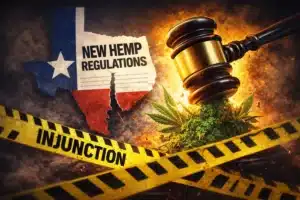
Now, in 2026, Judge Gamble is again presiding over a case with major implications for Texas hemp.
With THCA flower representing roughly 50% of hemp product sales, the current litigation could determine the industry’s future.
So far, Judge Gamble has:
Granted a Temporary Restraining Order (TRO)
Allowed continued sales of THCA flower—for now
Set a Temporary Injunction Hearing for Friday, April 23 at 9 AM
That hearing is expected to be pivotal.
It could decide:
Whether THCA flower remains legal in Texas
How aggressively the state can regulate hemp moving forward
Whether small operators survive the next phase of enforcement
A Pattern of Consequence
Across three very different cases, a pattern emerges:
Alex Jones → financial accountability at scale
Sweet Sensi → industry-level precedent and media scrutiny
THCA litigation → the future of hemp commerce in Texas
And in each instance, Judge Maya Guerra Gamble has been at the center.
A Publisher in the Crosscurrents
From appearing in an HBO documentary about Alex Jones…
To having my magazines entered into court as evidence…
To now covering—and being part of—the ongoing fight over hemp…
This isn’t just reporting from the sidelines.
It’s being in the middle of it.
What Happens Next
All eyes are now on the April 23rd injunction hearing.
What’s decided in that courtroom could:
Reshape the Texas hemp market
Determine the fate of THCA flower
And once again place Judge Gamble at the center of a high-impact ruling
Before algorithms decided what Americans should think, before podcasts became corporate, and long before “alternative media” was a marketing category, there was Austin, Texas—hot, strange, conspiratorial, and wide open. Out of that chaos emerged Alex Jones: a bullhorn-wielding public-access firebrand who helped define a new era of outsider broadcasting and permanently altered the landscape of independent media.
I knew Alex in those early Austin days, when the city was still a weird crossroads of musicians, hackers, paranoids, libertarians, activists, pranksters, and true believers. This was a time when public-access television wasn’t a joke—it was a weapon. Cable studios, camcorders, and late-night airtime gave anyone with nerve and vision a chance to hijack the signal. Alex Jones didn’t just hijack it—he overclocked it.
Public Access as a Launchpad
In the mid-1990s, Alex Jones became a familiar and unavoidable presence on Austin public-access TV. Shirt sleeves rolled up, veins popping, voice cranked past eleven, he delivered monologues that blended government overreach, covert operations, corporate corruption, and historical revisionism into something closer to performance art than journalism. Whether you agreed with him or not almost didn’t matter—you watched.
Austin at the time was fertile ground for this kind of energy. The city incubated pirate radio, zines, underground magazines, access television personalities, and late-night call-in chaos. Alex understood instinctively that attention was currency. He also understood something many traditional journalists missed: people wanted narratives that challenged official stories, especially after Waco, Ruby Ridge, Oklahoma City, and the expanding surveillance state of the Clinton era.
Public access wasn’t a stepping stone for Alex—it was a proving ground.
The Birth of InfoWars
What began as a local broadcast evolved into something much bigger. InfoWars grew from a scrappy Austin operation into one of the most influential—and controversial—alternative media platforms in modern American history. Long before YouTube demonetization, shadow bans, or platform censorship became mainstream topics, Alex was building his own infrastructure: websites, radio syndication, mailing lists, direct-to-consumer sales, and loyal audiences that bypassed traditional gatekeepers entirely.
This was pioneering work. Love him or loathe him, Alex Jones proved that you didn’t need a newsroom, a network, or institutional approval to reach millions. He demonstrated that outrage, narrative framing, and direct audience connection could outperform polished suits and teleprompters.
Many who later built podcasts, Substacks, and independent media brands—knowingly or not—walked through doors Alex kicked open.
The Performance and the Persona
Alex Jones is not subtle. He never was. His genius—and his downfall—lies in his amplification. He treats broadcasting as confrontation, not conversation. The Alex Jones persona is part preacher, part carnival barker, part political street fighter. It’s a style rooted as much in wrestling promos and talk radio as in investigative journalism.
That approach made him unforgettable—and also dangerous to himself. As InfoWars grew, so did scrutiny, backlash, lawsuits, and cultural warfare. The same refusal to self-edit that fueled his rise also hardened him into a symbol: for supporters, a truth-telling rebel; for critics, a cautionary tale of unchecked rhetoric.
Alex Jones July 2001
In Weird Magazine terms, Alex Jones is a media cryptid—a creature born of the American subconscious, impossible to ignore, impossible to fully categorize.
Austin Origins, American Impact
It’s important to remember that Alex Jones is not a coastal media invention. He’s an Austin original—shaped by Texas independence, Southern distrust of authority, and a city that once thrived on letting weird experiments run wild. Austin gave him the runway; America gave him the megaphone.
Whether history ultimately remembers him as a pioneer, a provocateur, or a warning sign, one fact remains indisputable: Alex Jones helped redefine what independent media could be. He proved that outsiders could build empires, that public access could scale to global reach, and that belief—right or wrong—moves audiences more powerfully than neutrality ever has.
Weird Magazine, InfoWars, and the Print Underground (2002–2012)
What often gets lost in the digital retelling of the InfoWars story is its deep print-media footprint, particularly within Austin’s alternative press ecosystem. From 2002 through 2012, InfoWars articles and Prison Planet editorials from the Alex Jones camp appeared consistently in the pages of both the Austin Para Times and Weird Magazine—long before algorithm-driven distribution reshaped media economics.
This was not incidental exposure. It was a cross-pollination of underground media cultures: public-access television, pirate radio, print magazines, and early web publishing all feeding the same audience hungry for narratives outside institutional consensus.
No YouTube, no social media, no instant access to information.
During this period people listened to radio, waited for Wednesdays at 7pm on cable channel 10 to watch the Alex Jones show, not because you knew what was coming; but you watched the show to see what wasn’t coming! You never knew what tirade of anti government, spit of rage Jones was about to launch into at any moment. And often it was comical full of satire and humor with just enough edge that the point was made like no other late night talk show host had ever delivered before or since.
During this period, Alex Jones frequently shared and promoted Weird Magazine on his local Austin public-access programs, highlighting coverage that profiled his investigations, editorials, and worldview.
In the summer of 2012, that relationship formalized.
Alex Jones hired (me) Russell Dowden to manage and produce InfoWars Magazine July 1st 2012 , bringing the underground print ethos into a dedicated, national-facing publication. From 2012 to 2014, Dowden served as General Manager of InfoWars Magazine, or advertising executive overseeing production, operations, and editorial execution or managing advertising sales during a critical growth phase for the brand.
At a time when many media outlets were abandoning print entirely, InfoWars Magazine represented a deliberate counter-move—physical media as ideological artifact, designed to be collected, shared, and passed hand to hand. The magazine bridged Alex Jones’ broadcast persona with long-form editorial content, mirroring the earlier Weird Magazine model that had proven alternative ideas could survive—and thrive—outside corporate publishing structures.
This period stands as a reminder that InfoWars was not built solely on outrage clips or viral moments. It was also built on ink, paper, late-night layout sessions, and Austin’s long tradition of do-it-yourself publishing—a lineage that Weird Magazine helped establish and sustain.
Final Transmission
Weird Magazine exists to document the fringes before they become the center. Alex Jones came from the fringe and dragged it onto the main stage, kicking and screaming. His story is inseparable from Austin’s lost era of analog rebellion and America’s ongoing information war.
You don’t have to endorse the message to acknowledge the impact.
And you can’t tell the story of modern alternative media without saying his name.
The March 3 hearing showcased the best anti-THC talking points from the 1970’s, 80’s and beyond. Like a hit parade of bogus tunes, here’s the Top Ten Prohibitionist Lies
1. “Marijuana is a Gateway Drug”
• Falsehood: Using marijuana leads people to use harder drugs like heroin or meth.
• Reality: Numerous studies, including from the National Institute on Drug Abuse (NIDA), show no causal link between marijuana use and subsequent hard drug use. The real gateway factors tend to be socioeconomic conditions, trauma, or early exposure to addictive substances like alcohol and nicotine.
• Reality: Crime statistics from states that have legalized cannabis (e.g., Colorado, Washington) show no significant rise in violent crime—and some cities have even reported decreases. In contrast, illegal drug trade violence often decreases when legal markets replace black market sales.
3. “Marijuana Lowers IQ and Makes People Lazy”
• Falsehood: Long-term cannabis use reduces intelligence and destroys motivation.
• Reality: Studies show no significant IQ drop in adults who use cannabis. While adolescent overuse may impact cognitive development, occasional adult use has not been linked to measurable declines in intelligence. Moreover, many successful professionals and creatives openly use cannabis without suffering motivational issues.
4. “Marijuana is as Dangerous as Heroin and Fentanyl”
• Falsehood: Cannabis is a “Schedule I drug” because it’s highly addictive and has no medical benefits.
• Reality: Marijuana is not chemically addictive in the way opioids or nicotine are, and it has established medical benefits for pain, epilepsy, PTSD, and more. In fact, it is far less harmful than alcohol and prescription painkillers.
5. “Legalization Leads to More Teen Use”
• Falsehood: When states legalize marijuana, more teenagers will start using it.
• Reality: Studies from The Journal of the American Medical Association (JAMA) and Colorado Department of Public Health show no increase in youth marijuana use post-legalization. In fact, some states have seen decreases in underage use due to better regulation.
• Reality: This myth originated from a flawed 1970s study where researchers suffocated monkeys with excessive cannabis smoke, depriving them of oxygen. Modern neuroscience shows that cannabis affects brain function but does not destroy brain cells.
7. “People Overdose on Marijuana”
• Falsehood: Cannabis use leads to lethal overdoses.
• Reality: There are zero recorded deaths from cannabis overdose. While high doses can cause discomfort, anxiety, or nausea, it does not suppress respiratory function like opioids.
8. “Legal Marijuana States Have More DUIs and Traffic Accidents”
• Falsehood: Marijuana legalization leads to more impaired driving and crashes.
• Reality: While THC can impair driving ability in some cases, overall crash rates have not spiked in legal states. Many studies indicate that drunk driving is a far bigger problem than cannabis-impaired driving.
9. “Marijuana Has No Legitimate Medical Use”
• Falsehood: There is no scientific evidence supporting medical marijuana.
• Reality: Cannabis is FDA-approved for multiple conditions, and studies confirm its effectiveness in treating epilepsy (CBD), chronic pain, nausea from chemotherapy, PTSD, and multiple sclerosis. The U.S. government even holds a patent on cannabinoids for their neuroprotective effects.
10. “Marijuana Legalization Harms the Economy”
• Falsehood: Legal weed will damage businesses and hurt the economy.
• Reality: Legal cannabis is one of the fastest-growing industries, generating billions in tax revenue, creating hundreds of thousands of jobs, and reducing costs related to law enforcement
On Tuesday, August 27th, Allen Police raided nine hemp shops, accusing them of selling illegal
products containing higher-than-allowed levels of THC. Texas Hemp lawyer David Sergi, who
represents eight of the nine store owners, stated that his clients were operating legally under
both Texas and Federal law.
San Marcos-based attorney Sergi emphasized that his clients are being accused of
manufacturing and distributing illegal tetrahydrocannabinol (THC) products, but under current
state and federal guidelines, the products they sell are legally permissible.
Who is at Fault?
While many argue that the Allen Police Department overstepped by executing search and
seizure warrants, there is a broader context. The DEA had been conducting a joint task force
investigation, targeting similar shops less than a month prior. Subpoenas were issued to several
of these same store owners earlier in the summer, with the DEA seeking access to financial
documents, customer transactions, and supplier lists—requests that Sergi claims violate the
Fourth and Fifth Amendments to the U.S. Constitution.
Sergi, who previously helped overturn a statewide ban on consumable hemp products,
successfully defended his clients against these subpoenas. In that case, a federal judge ruled
that the DEA could not obtain the requested information, marking a significant victory for the
businesses involved.
“This is straight out of a Russian KGB novel or a mafia gangster film,” Sergi remarked,
comparing the heavy-handed tactics to fiction.
The stores recently raided, including Lit Smoke & Vape, Chasing Vapes, and Hazel Sky, are some
of the same businesses Sergi represents in ongoing legal battles with the Allen Hemp Coalition.
Fighting Back
AJ Velador, founder of Hemp Industry Leaders of Texas (HILT), is organizing a GoFundMe page
to assist with bond and legal expenses for those affected by the raids. Velador and his
organization aim to put an end to what they see as unlawful and disruptive actions against legal
hemp operators and retailers in Texas.
Sergi echoed Velador’s concerns, describing the raids as poorly conceived and
counterproductive. The coalition, comprised of small, family-owned businesses, provides
employment to many in the Allen area and serves customers in need of legal cannabinoids,
such as veterans and individuals suffering from pain and PTSD, as alternatives to opioids.
Sergi further warned that the city’s actions could inadvertently open the door for cartels to step
in with unregulated and dangerous products. Industry professionals, he said, strive to work with
law enforcement to ensure that compliant products are sold to adult consumers.
The Bigger Picture for Hemp Operators
The ongoing raids have raised several critical questions for hemp business operators. How is
law enforcement testing these products? Are they using the same standards that certified labs
use to issue Certificates of Analysis (COAs)?
These concerns are especially pressing as the hemp industry faces a new legislative session,
during which lawmakers are expected to address product labeling, packaging, and age
restrictions. The May 2024 hearing of the State Affairs Committee highlighted these issues.
Sergi & Associates Response
David Sergi argues that the actions of the Allen Police Department and the DEA represent a
clear escalation of tactics used across the state to intimidate businesses selling legal hemp-
based products. According to Sergi, the raids resulted in the destruction of products, the seizure
of point-of-sale systems, and the confiscation of personal computers belonging to
employees—all actions that he contends were unlawful.
“These businesses are operating legally under Texas law,” Sergi said. “There is a right way and a
wrong way to address compliance concerns, and they have chosen the wrong way. They will be
held accountable.”
Sergi is no stranger to cases like this. He also defended Sky & Hobbs after their indoor growing facility was raided by Navarro County sheriffs in 2021.
The Allen Hemp Coalition, representing many of the affected businesses, is currently fighting in
court to uphold their legal rights to operate. Sergi and his team have already successfully stayed
a DEA subpoena they deemed a blatant “fishing expedition.”